The 60-Second Version
Bitcoin mining, once the niche province of cypherpunks, has matured into a $30 billion publicly traded industry that looks less like a speculative gold rush and more like a core piece of energy infrastructure. The core thesis is simple: industrial-scale Bitcoin miners are no longer just earning crypto; they are energy arbitrage specialists, converting underutilized power into a global digital commodity. With the 2024 Bitcoin halving squeezing margins, the savviest players are executing a strategic pivot, leveraging their vast data center and power infrastructure to service the insatiable demand for AI and high-performance computing (HPC). This isn’t about the price of Bitcoin rocketing to the moon; it’s about a new, durable business model where miners sell computational power to the highest bidder, whether that’s the Bitcoin network or a major AI cloud provider. This pivot is attracting serious attention from institutional giants like Blackstone and KKR, who recognize the makings of a resilient, cash-flow-generating infrastructure play. For investors, this means looking past the daily volatility of crypto and seeing the long-term value in the picks and shovels of the digital age—the data centers, the power contracts, and the energy grids that underpin the next wave of technological innovation.
I. What Bitcoin Mining Investing Actually Is
Investing in Bitcoin mining is not the same as buying Bitcoin. When you invest in a Bitcoin mining company, you are buying equity in a business that operates at the intersection of technology, energy, and finance. At its core, you are purchasing a stake in a company’s ability to efficiently convert electricity into computational power, or “hash rate.” This hash rate is then used to solve complex mathematical problems, which validates transactions on the Bitcoin network and, in return, earns the miner newly created Bitcoin (the “block reward”) and transaction fees.
Historically, the investment case was a direct, leveraged bet on the price of Bitcoin. If Bitcoin’s price rose, a miner’s revenue would increase, and their stock price would often multiply that gain. However, the modern Bitcoin mining investment thesis is more nuanced. Today, you are investing in a sophisticated energy and infrastructure business. These companies build and operate large-scale data centers, secure long-term, low-cost power purchase agreements (PPAs), and manage complex logistics to maintain thousands of specialized computers (ASICs). The returns are generated not just from the appreciation of Bitcoin, but from the operational efficiency of the mining process itself. The most successful miners are those who can acquire electricity at the lowest cost, deploy the most energy-efficient hardware, and maintain the highest possible uptime. As the industry evolves, returns are also increasingly being generated from a new, powerful source: leasing out their infrastructure for non-crypto purposes like AI and HPC, creating a diversified revenue stream that is less dependent on the volatile crypto markets.
II. The Market
The Bitcoin mining market has evolved from a hobbyist pursuit into a global, multi-billion-dollar industry. The market for publicly traded mining companies alone has a collective market capitalization exceeding $30 billion. The revenue generated by these miners is substantial, with estimates placing it at over $15 billion annually. While the 2024 halving event temporarily reduced the block reward, the continued growth of the network and the pivot to new revenue streams have solidified the industry’s economic foundation.
The global cryptocurrency mining market as a whole was valued at $1.55 billion in 2024 and is projected to grow to $2.83 billion by 2032, reflecting a compound annual growth rate (CAGR) of 7.8%. This growth is underpinned by the increasing mainstream acceptance of digital assets and continuous innovation in mining hardware and techniques.
Key Milestones in Bitcoin Mining
| Year | Milestone | Significance |
|---|---|---|
| 2009 | Genesis Block Mined | Satoshi Nakamoto mines the first block on the Bitcoin network, starting the process of decentralized transaction validation. |
| 2010 | First GPU Mining | The first GPU (Graphics Processing Unit) miner is created, marking a significant increase in hash rate and the beginning of the professionalization of mining. |
| 2012 | First Bitcoin Halving | The block reward is halved from 50 BTC to 25 BTC, introducing the first major test of the network's economic model. |
| 2013 | First ASIC Miners | The introduction of Application-Specific Integrated Circuits (ASICs) renders GPU mining obsolete for Bitcoin, leading to an arms race in hardware development. |
| 2016 | Second Bitcoin Halving | The block reward is halved again, to 12.5 BTC, further increasing the importance of operational efficiency for miners. |
| 2017 | Bitcoin Price Peak and Mining Boom | Bitcoin's price reaches nearly $20,000, leading to a massive influx of investment into the mining sector and a surge in global hash rate. |
| 2020 | Third Bitcoin Halving | The block reward is reduced to 6.25 BTC, placing even greater pressure on miners to secure low-cost energy and efficient hardware. |
| 2021 | China Bans Bitcoin Mining | China, once the global hub of Bitcoin mining, bans all mining activities, leading to a massive migration of hash rate to North America and other regions. |
| 2022 | Public Miners' Market Cap Peaks | The total market capitalization of publicly traded Bitcoin mining companies reaches a new high, reflecting growing investor confidence in the sector. |
| 2024 | Fourth Bitcoin Halving & The AI Pivot | The block reward is halved to 3.125 BTC. In response to tightening margins, major miners begin to pivot their infrastructure to service the AI and HPC markets, marking a new era of revenue diversification. |
| 2025 | Institutional Investment | Major institutional players like Blackstone and KKR begin to show significant interest in the Bitcoin mining sector, viewing it as a critical infrastructure play. |
III. The Demand Drivers
The bull case for Bitcoin mining is no longer solely about the price of Bitcoin. A confluence of powerful, structural trends is driving demand for the infrastructure and services that miners provide. These drivers are transforming the industry from a speculative crypto play into a resilient, multi-faceted infrastructure business.
1. The Insatiable Demand for AI and High-Performance Computing (HPC)
The single most important new demand driver for Bitcoin miners is the explosive growth of the AI and HPC sectors. The computational power required to train large language models (LLMs) and run complex simulations is staggering, and the demand for data center capacity is far outstripping supply. Morgan Stanley predicts that power demand from data centers will skyrocket by 74 gigawatts by 2028, and Bitcoin miners are perfectly positioned to capture a significant share of this market. They possess three key advantages:
- •Existing Infrastructure: Miners have already built out large-scale, high-density data centers in locations with access to cheap power.
- •Power Expertise: They are world-class experts in securing and managing massive amounts of electricity, a core competency that is directly transferable to AI/HPC hosting.
- •Speed to Market: Converting a mining facility to an AI data center is significantly faster and cheaper than building a new one from scratch. Companies like Core Scientific and Iris Energy are already generating significant revenue from this pivot, leasing their infrastructure to AI and cloud computing clients.
2. The Monetization of Stranded and Curtailed Energy
Bitcoin mining is a uniquely flexible and mobile energy consumer. This allows miners to act as an “energy buyer of last resort,” monetizing power that would otherwise be wasted. This creates a powerful symbiosis with the energy sector, particularly in the realm of renewables. For example:
- •Stranded Gas: At oil and gas extraction sites, natural gas is often flared (burned off) because it is not economical to transport it to market. Miners can set up mobile data centers on-site, convert this flared gas into electricity, and use it to mine Bitcoin. This not only provides them with extremely low-cost power but also reduces methane emissions.
- •Renewable Energy Stabilization: Wind and solar power are intermittent, meaning they don’t produce electricity 24/7. This creates challenges for grid stability. Bitcoin miners can act as a flexible load, absorbing excess power when production is high and shutting down when demand on the grid is high. This helps to balance the grid and makes renewable energy projects more economically viable.
3. The Continued Growth and Security of the Bitcoin Network
While the AI pivot is a major new development, the original demand driver for Bitcoin mining remains as relevant as ever: the need to secure the Bitcoin network. As the value of the Bitcoin network grows, so does the need for a robust and decentralized security layer. Miners provide this security by dedicating their hash rate to validating transactions and adding them to the blockchain. The more hash rate on the network, the more secure it is from attack. The continued adoption of Bitcoin as a global store of value and a hedge against inflation ensures that there will be a persistent demand for the security that miners provide.
4. Financialization and Institutional Adoption
The Bitcoin mining industry is rapidly maturing and attracting the attention of institutional investors. The launch of Bitcoin mining ETFs like the Valkyrie Bitcoin Miners ETF (WGMI) and the Bitwise Crypto Industry Innovators ETF (BITQ) has made it easier for mainstream investors to gain exposure to the sector. Furthermore, private equity giants like Blackstone and KKR are reportedly exploring investments in the space, recognizing the potential for stable, long-term returns from this new class of infrastructure assets. This influx of institutional capital is providing miners with the resources they need to scale their operations, upgrade their hardware, and execute on the AI/HPC pivot, creating a virtuous cycle of growth and professionalization.
IV. The Players
The Bitcoin mining landscape is dominated by a mix of publicly traded giants, specialized hardware manufacturers, and large private operations. These companies are increasingly sophisticated, with complex strategies spanning energy procurement, hardware deployment, and now, AI/HPC hosting.
| Name | Type | AUM/Scale | Notable |
|---|---|---|---|
| Marathon Digital Holdings (MARA) | Publicly Traded Miner | One of the largest miners by hash rate; ~25 EH/s | Has pursued a strategy of aggressive growth and vertical integration, owning and operating its own facilities. Initially focused purely on Bitcoin, but now exploring diversification. |
| Riot Platforms (RIOT) | Publicly Traded Miner | Large-scale miner with significant infrastructure; ~12.4 EH/s | A leader in leveraging energy arbitrage and grid services, particularly in Texas. Has made strategic investments in other mining companies. |
| Core Scientific (CORZ) | Publicly Traded Miner & Hosting Provider | Operates one of the largest fleets of miners in North America | A major player in the AI/HPC pivot, leveraging its extensive data center infrastructure to provide hosting for AI clients. Emerged from bankruptcy in 2024 with a renewed focus on this hybrid model. |
| Iris Energy (IREN) | Publicly Traded Miner & AI/HPC Provider | Operates data centers powered by 100% renewable energy | An early mover in the AI/HPC space, securing a significant contract with an AI cloud provider. Demonstrates the viability of the renewable-powered data center model. |
| CleanSpark (CLSK) | Publicly Traded Miner | Known for its focus on operational efficiency and acquiring mining facilities | Has a strong track record of acquiring and optimizing mining operations, often using a mix of renewable and traditional energy sources. |
| Bitfarms (BITF) | Publicly Traded Miner | Global operations with a focus on renewable energy | Rebranding to "Keel Infrastructure" to reflect its pivot towards a broader infrastructure strategy beyond just Bitcoin mining. |
| Hut 8 Corp. (HUT) | Publicly Traded Miner & Data Center Operator | One of the oldest and most established miners | Merged with US Bitcoin Corp and is actively converting portions of its mining operations into AI power centers, including a partnership with Anthropic. |
| Bitmain | Private Hardware Manufacturer | The world's largest manufacturer of Bitcoin mining ASICs (Antminer series) | Dominates the hardware market. Its product releases and pricing have a significant impact on the entire mining industry's economics. |
| Foundry USA | Mining Pool | The largest Bitcoin mining pool by hash rate | A subsidiary of Digital Currency Group (DCG), it provides services to a large number of individual and institutional miners, aggregating their hash rate. |
V. Geography
The geography of Bitcoin mining is a direct reflection of global energy markets and regulatory landscapes. Miners are constantly seeking out the cheapest, most reliable sources of power, leading to a fluid and ever-shifting distribution of hash rate around the world. The 2021 ban on cryptocurrency mining in China, which at the time accounted for over 65% of the global hash rate, triggered a massive and unprecedented migration of mining operations, fundamentally reshaping the industry’s geographic footprint.
Today, North America stands as the undisputed leader in the Bitcoin mining industry, with the United States alone accounting for an estimated 37.5% of the global hash rate. This dominance is driven by a combination of factors, including access to cheap natural gas, a growing portfolio of renewable energy sources, and a relatively stable regulatory environment. States like Texas, Georgia, and Wyoming have become major mining hubs, attracting billions of dollars in investment.
Global Hash Rate Distribution (Q1 2026)
| Rank | Country | Est. Global Hash Rate Share | Key Drivers |
|---|---|---|---|
| 1 | United States | 37.5% | Abundant cheap energy (natural gas, renewables), stable regulation, access to capital markets. |
| 2 | Russia | 16.4% | Vast reserves of cheap natural gas and hydropower, cold climate reduces cooling costs. |
| 3 | China | 11.7% | Despite the ban, underground operations persist, leveraging seasonal hydropower and proximity to hardware manufacturers. |
| 4 | Paraguay | 4.0% | Surplus hydroelectric power from the Itaipú Dam provides some of the lowest electricity costs in the world. |
| 5 | UAE | 3.1% | Strong government support, access to capital, and investment in advanced cooling technologies to combat the hot climate. |
| 6 | Oman | 3.0% | State-supported energy initiatives and a strategic push to monetize energy resources through compute. |
| 7 | Canada | 2.6% | Abundant hydroelectric power, particularly in Quebec and British Columbia. |
| 8 | Ethiopia | 2.6% | Rapidly growing market leveraging underutilized hydroelectric capacity. |
| 9 | Kazakhstan | 2.1% | Declining from previous highs due to increased regulation and grid strain, but still a notable player. |
| 10 | Indonesia | 2.1% | Emerging market with growing energy infrastructure and increasing adoption of digital assets. |
Source: Hashrate Index, Q1 2026 Estimates
VI. How to Actually Invest
Investing in the Bitcoin mining ecosystem has become increasingly accessible, with a range of options available to suit different risk appetites and investment sizes. Unlike the early days, which required significant technical expertise, today’s investors can choose from direct equity in publicly traded companies, diversified ETFs, and even cloud mining contracts.
| Vehicle | Min Investment | Liquidity | Expected Return | Risk Level |
|---|---|---|---|---|
| Public Mining Stocks | Low (cost of 1 share) | High (traded on major exchanges) | High (leveraged to BTC price and operational success) | High |
| Bitcoin Mining ETFs | Low (cost of 1 share) | High (traded on major exchanges) | Medium-High (diversified across the sector) | Medium-High |
| Cloud Mining Contracts | Medium ($500+) | Low (often locked into contracts) | Medium (dependent on provider's efficiency and BTC price) | Very High |
| Direct Hardware Purchase (Hosted) | High ($10,000+) | Very Low (illiquid hardware, long-term contracts) | High (direct exposure to mining rewards, but high costs) | Very High |
| Private Equity / Venture Capital | Very High ($250,000+) | Very Low (long lock-up periods) | Very High (potential for outsized returns from early-stage companies) | Very High |
Publicly Traded Mining Stocks
This is the most common and liquid way to invest in the sector. By purchasing shares in companies like Marathon Digital (MARA), Riot Platforms (RIOT), or CleanSpark (CLSK), you are gaining direct exposure to their operational performance, management strategy, and the underlying value of their assets (including their Bitcoin holdings and data center infrastructure). These stocks are highly correlated with the price of Bitcoin but also offer the potential for upside based on operational excellence and successful diversification into areas like AI hosting.
Bitcoin Mining ETFs
For investors seeking diversified exposure without picking individual stocks, ETFs are an excellent option. The Valkyrie Bitcoin Miners ETF (WGMI) and the Grayscale Bitcoin Miners ETF (MNRS) are two prominent examples. These funds hold a basket of publicly traded mining companies, spreading the risk and providing a more general exposure to the industry’s overall health and growth. This approach can mitigate the company-specific risks associated with single-stock investing.
Cloud Mining Contracts
Cloud mining allows individuals to rent hash power from a large-scale mining operation without owning the physical hardware. You pay a fee to a provider who then manages the miners and sends you the earned Bitcoin. While this lowers the barrier to entry, it is a very high-risk approach. The space is rife with scams, and even legitimate providers may have unfavorable contract terms that make it difficult to turn a profit, especially in a post-halving environment. Extreme caution and due diligence are required.
Direct Hardware Purchase and Hosting
For those with significant capital and a high-risk tolerance, it is possible to purchase your own ASIC miners and have them hosted in a professional data center. This provides direct ownership of the hardware and the full benefit of the mining rewards. However, it requires a substantial upfront investment (often $10,000 or more per machine), and you are exposed to the risks of hardware failure, depreciation, and changing market conditions. This is an option best suited for sophisticated investors with a deep understanding of the industry.
Private Equity and Venture Capital
Accredited investors can also gain exposure through private equity and venture capital funds that specialize in the digital asset space. These funds invest in early-stage mining companies and related infrastructure projects. This offers the potential for very high returns but comes with very long lock-up periods and a high degree of risk. This is the domain of institutional investors and high-net-worth individuals.
VII. Unit Economics
To understand the business of Bitcoin mining, it’s essential to break down the economics of a single unit of production—in this case, a single, latest-generation ASIC miner. The profitability of this unit is a direct function of its efficiency, the cost of power, and the price of Bitcoin. The 2024 halving fundamentally reset this equation, making operational excellence and access to cheap power more critical than ever.
Let’s analyze the unit economics of a top-tier ASIC miner, the Antminer S21, in a post-halving environment. This provides a clear picture of the revenue and cost drivers that determine a miner’s profitability.
Unit Economics of a Single Antminer S21
| Metric | Value | Notes |
|---|---|---|
| Hardware Cost | $4,000 | The upfront capital expenditure for one ASIC miner. This can fluctuate based on market demand. |
| Hash Rate | 200 TH/s | The computational power of the miner (Terahashes per second). |
| Power Consumption | 3,500 Watts | The amount of electricity the miner consumes per hour. |
| Energy Efficiency | 17.5 J/TH | A key metric of performance (Joules per Terahash). Lower is better. |
| Electricity Cost | $0.05 / kWh | A competitive, industrial-scale power rate. This is the single most important variable. |
| Daily Power Consumption | 84 kWh | (3,500 Watts * 24 hours) / 1,000 |
| Daily Electricity Cost | $4.20 | 84 kWh * $0.05/kWh |
| Daily BTC Mined* | ~0.00009 BTC | This is highly dependent on the total network hash rate and mining difficulty at any given time. |
| Daily Revenue (at $70,000 BTC)* | $6.30 | 0.00009 BTC * $70,000 |
| Daily Gross Profit | $2.10 | $6.30 (Revenue) - $4.20 (Electricity Cost) |
| Hardware Payback Period | ~1,905 days (5.2 years) | $4,000 (Hardware Cost) / $2.10 (Daily Gross Profit) |
*Note: Daily BTC mined and revenue are estimates and will fluctuate with network difficulty and Bitcoin price.
This table starkly illustrates the post-halving reality. Even with a competitive electricity rate, the payback period for new hardware is over five years if relying solely on Bitcoin mining revenue. This is why the pivot to AI/HPC hosting is so critical. An AI client might pay a significant premium for the same power and infrastructure, dramatically shortening the payback period and increasing the overall return on investment.
For example, if that same 3,500-watt slot could be leased to an AI client for $0.15 per kWh, the daily revenue would be $12.60 (84 kWh * $0.15), and the daily gross profit would be $8.40. This would reduce the hardware payback period to just ~476 days (1.3 years), a far more attractive proposition for investors.
This dual-revenue potential is the core of the modern Bitcoin mining investment thesis. The most successful miners will be those who can dynamically allocate their infrastructure to the most profitable computational task, whether that is securing the Bitcoin network or training the next generation of artificial intelligence.
VIII. Macroeconomic Sensitivity
Bitcoin mining, as an industry, exhibits a unique and evolving sensitivity to the broader macroeconomic environment. While it was once seen as a completely separate ecosystem, its increasing integration into traditional financial markets and its reliance on global energy and capital markets have made it susceptible to macro shifts. However, its unique characteristics also provide potential hedges against certain economic conditions.
| Macro Regime | Impact on Bitcoin Mining | Historical Example |
|---|---|---|
| High Inflation, Low Growth (Stagflation) | Mixed/Positive: As a producer of a scarce digital asset, miners can benefit from Bitcoin's appeal as an inflation hedge. However, high energy costs and a weak consumer can compress margins and reduce demand for risk assets. | 2021-2022: While Bitcoin's price initially rose with inflation, the subsequent tightening by central banks led to a sharp downturn in crypto markets, putting severe pressure on miners. |
| High Inflation, High Growth | Positive: A strong economy with high inflation is often the most favorable environment. Bitcoin's price tends to perform well as an inflation hedge, and a strong economy supports investor risk appetite. Miners' revenues increase, and access to capital is plentiful. | Post-COVID Boom (2020-2021): The combination of massive fiscal stimulus, low interest rates, and rising inflation fears created a perfect storm for Bitcoin and the mining industry, leading to a major bull run. |
| Low Inflation, High Growth | Neutral/Positive: In a stable, growing economy, risk assets generally perform well. While the inflation hedge narrative is less prominent, the overall positive market sentiment and access to cheap capital are beneficial for miners looking to expand and upgrade their operations. | Mid-2010s: A period of relatively stable growth and low inflation saw a steady increase in Bitcoin adoption and the professionalization of the mining industry. |
| Low Inflation, Low Growth (Deflation/Recession) | Negative: This is typically the most challenging environment. In a recession, investor appetite for risk assets like Bitcoin plummets. Capital becomes scarce, making it difficult for miners to fund operations and expansion. While lower energy costs can provide some relief, the drop in Bitcoin's price is usually the dominant factor. | 2018 "Crypto Winter": Following the 2017 peak, a prolonged bear market and a cooling global economy led to a wave of bankruptcies and consolidation in the mining industry. |
The pivot to AI/HPC hosting adds a new and important dimension to this analysis. The demand for AI computing is largely decoupled from traditional economic cycles. It is driven by a long-term, structural technological shift. This means that even in a recessionary environment where Bitcoin’s price may be suppressed, miners with a diversified revenue stream from AI clients could see stable or even growing cash flows. This transformation from a pure-play crypto asset producer to a diversified computational infrastructure provider significantly enhances the industry’s resilience to macroeconomic shocks.
IX. Tax Considerations: A Global Overview
The tax treatment of Bitcoin mining is a complex and evolving area of law, with significant variations between jurisdictions. For any serious investor, understanding these differences is crucial, as they can have a substantial impact on the profitability of a mining operation. Generally, the key distinction is whether mining is treated as a business activity, a hobby, or a capital gains event.
| Jurisdiction | Tax Treatment of Mining Rewards | Key Considerations |
|---|---|---|
| United States | Taxed as Income: Mined cryptocurrency is treated as gross income, valued at its fair market value on the date it is received. If mining is conducted as a business, miners can deduct ordinary and necessary business expenses (e.g., electricity, hardware depreciation). | The IRS has been increasing its focus on crypto tax compliance. Miners must keep meticulous records of when they received crypto and its value at that time. Subsequent sale of the mined crypto is a separate capital gains event. |
| United Kingdom | Depends on Activity Level: For most individuals, mining is considered a hobby, and the rewards are not subject to income tax. However, if the activity is significant and organized (a "trade"), the rewards are taxed as trading income. | HMRC provides a "trading allowance" of £1,000 per year. If mining income is below this threshold, it does not need to be declared. The distinction between a hobby and a trade is based on factors like organization, risk, and commerciality. |
| European Union | Varies by Member State: There is no single, unified tax policy for crypto across the EU. However, a landmark Court of Justice of the European Union (CJEU) ruling exempted the exchange of Bitcoin from VAT. Mining rewards are generally treated as income, but the specifics vary. | Germany, for example, treats mined crypto as private money, and if held for over a year, it can be sold tax-free. Other countries have different rules, making it essential to consult local tax advisors. |
| Singapore | Depends on Intent: If you are mining as a hobby, the rewards are not taxed. If you are operating a commercial mining business with the intent to profit, the rewards are taxed as business income. | Singapore is generally considered a crypto-friendly jurisdiction with no capital gains tax. The key is whether the mining activity is structured as a formal business. |
| United Arab Emirates | Generally Tax-Free (for now): The UAE currently has no federal income tax for individuals, so mining rewards are generally not taxed. However, the UAE has introduced a Value Added Tax (VAT) and corporate tax, and recent clarifications suggest that certain mining activities could be subject to these taxes if they are deemed a service. | The regulatory landscape is evolving. While currently very favorable, miners should monitor changes in corporate and VAT law. The UAE is positioning itself as a global crypto hub, but this will likely come with more formal regulations over time. |
| Australia | Taxed as Income (if a business): Similar to the U.S. and UK, the Australian Taxation Office (ATO) distinguishes between hobby mining and running a business. If it is a business, the mined crypto is taxed as ordinary income. | If you are a hobbyist, the first disposal of the mined crypto may be a capital gains event. The ATO looks at the scale, repetition, and commercial nature of the activity to determine if it constitutes a business. |
Disclaimer: This information is for educational purposes only and does not constitute tax advice. The tax laws surrounding cryptocurrency are complex and subject to change. You should consult with a qualified tax professional in your jurisdiction to understand your specific obligations.
X. Case Studies
The theoretical pivot from Bitcoin mining to AI/HPC hosting becomes much clearer when examining the real-world execution by industry leaders. These case studies demonstrate how miners are leveraging their core competencies in energy and infrastructure to build new, resilient revenue streams.
Case Study 1: Core Scientific's AI-Powered Turnaround
Background: Core Scientific (CORZ) was one of the largest publicly traded Bitcoin miners, but it was hit hard by the 2022 crypto winter and rising energy costs, ultimately filing for Chapter 11 bankruptcy. However, the company had a hidden asset: a massive portfolio of high-power data center infrastructure.
The Pivot: During its restructuring, Core Scientific made a strategic decision to aggressively pursue the AI/HPC hosting market. In early 2024, shortly after emerging from bankruptcy, the company announced a landmark deal to provide 16 MW of data center infrastructure to CoreWeave, a specialized cloud provider for large-scale AI workloads. This multi-year contract was projected to generate over $100 million in revenue.
The Outcome: The CoreWeave deal was a watershed moment, proving the viability of the miner-to-AI-host pivot at scale. It provided Core Scientific with a stable, high-margin, non-crypto revenue stream that was insulated from Bitcoin price volatility. The market responded enthusiastically, with CORZ’s stock price surging post-announcement. The company has since expanded its AI hosting business, leveraging its operational expertise to provide the high-density cooling and power required for the latest generation of NVIDIA GPUs. Core Scientific’s story is a powerful example of how infrastructure and energy expertise can create value far beyond the Bitcoin mining ecosystem.
Case Study 2: Iris Energy's Renewable-Powered AI Cloud
Background: Iris Energy (IREN) has always differentiated itself by powering its data centers with 100% renewable energy. This ESG-friendly approach, combined with a focus on low-cost power, positioned the company well for the energy-intensive business of Bitcoin mining.
The Pivot: Recognizing the growing demand for sustainable computing, Iris Energy was an early mover in the AI space. The company began re-engineering its data centers to accommodate the high-density power and cooling requirements of AI hardware. In late 2023, Iris Energy announced it had secured a contract to host AI cloud infrastructure, immediately putting its renewable-powered assets to work in this new market.
The Outcome: Iris Energy has successfully launched its “AI Cloud” service, offering GPU cloud solutions for AI training and inference. By leveraging its existing low-cost, renewable power contracts, the company is able to offer a compelling value proposition to AI clients who are increasingly focused on the environmental impact of their operations. The company has secured additional capacity and is rapidly expanding its AI hosting business, demonstrating that a sustainable approach to energy can be a significant competitive advantage in the new world of computational infrastructure.
Case Study 3: Hut 8's Merger and Diversification Strategy
Background: Hut 8 (HUT) is one of the oldest and most respected names in Bitcoin mining, with a long history of navigating market cycles. The company has always held a significant portion of its mined Bitcoin on its balance sheet, a strategy that has served it well during bull markets.
The Pivot: Rather than just pivoting its existing infrastructure, Hut 8 pursued a more ambitious strategy of diversification through a merger with US Bitcoin Corp. This created a new, more diversified entity with a broader portfolio of data center assets and a wider range of services. Following the merger, Hut 8 announced a partnership with the AI company Anthropic, signaling its clear intent to become a major player in the AI infrastructure space.
The Outcome: The new Hut 8 is a diversified infrastructure company with revenue streams from self-mining, managed services, and now, AI/HPC hosting. By converting portions of its mining facilities into dedicated AI power centers, the company is tapping into a new, high-growth market while maintaining its core competency in Bitcoin mining. This strategy of “and, not or” allows Hut 8 to benefit from the upside of Bitcoin while building a more stable, predictable revenue base from its infrastructure-as-a-service offerings.
XI. The Core Constraint
The single biggest structural challenge facing the Bitcoin mining industry is the scarcity of low-cost, reliable power. Every aspect of the mining business, from hardware selection to geographic location, is dictated by the pursuit of cheap electricity. The industry’s insatiable demand for energy creates a fundamental tension: miners need massive amounts of power to be profitable, but this very demand can strain local grids and attract the ire of regulators and environmental groups.
This constraint manifests in several ways:
- •Geographic Concentration: Miners are forced to cluster in regions with specific energy profiles, such as those with abundant hydropower (Quebec, Paraguay), stranded natural gas (Texas, Russia), or geothermal resources (El Salvador). This creates geographic risk and dependence on the political and regulatory stability of a small number of jurisdictions.
- •The Energy Arms Race: As the industry grows, the competition for cheap power intensifies. Miners must constantly seek out new energy sources and negotiate complex, long-term power purchase agreements (PPAs). This requires a level of energy market sophistication that was unheard of in the early days of mining.
- •Regulatory and Social Scrutiny: The high energy consumption of Bitcoin mining has made it a target for criticism. This has led to moratoriums and outright bans in some regions, and it forces miners to engage in a constant public relations battle to justify their energy use. The industry’s shift towards renewable energy and grid stabilization services is a direct response to this pressure.
The pivot to AI/HPC hosting, while a powerful new revenue stream, does not eliminate this core constraint; it intensifies it. AI workloads are even more power-hungry than Bitcoin mining, and the demand for AI-ready data centers is putting further pressure on already strained power grids. The winners in this new era will be the companies that can master the energy game—those who can secure, manage, and deploy massive amounts of low-cost power more effectively than their competitors. The future of the industry will be written not in code, but in megawatts.
XII. Inside the Asset
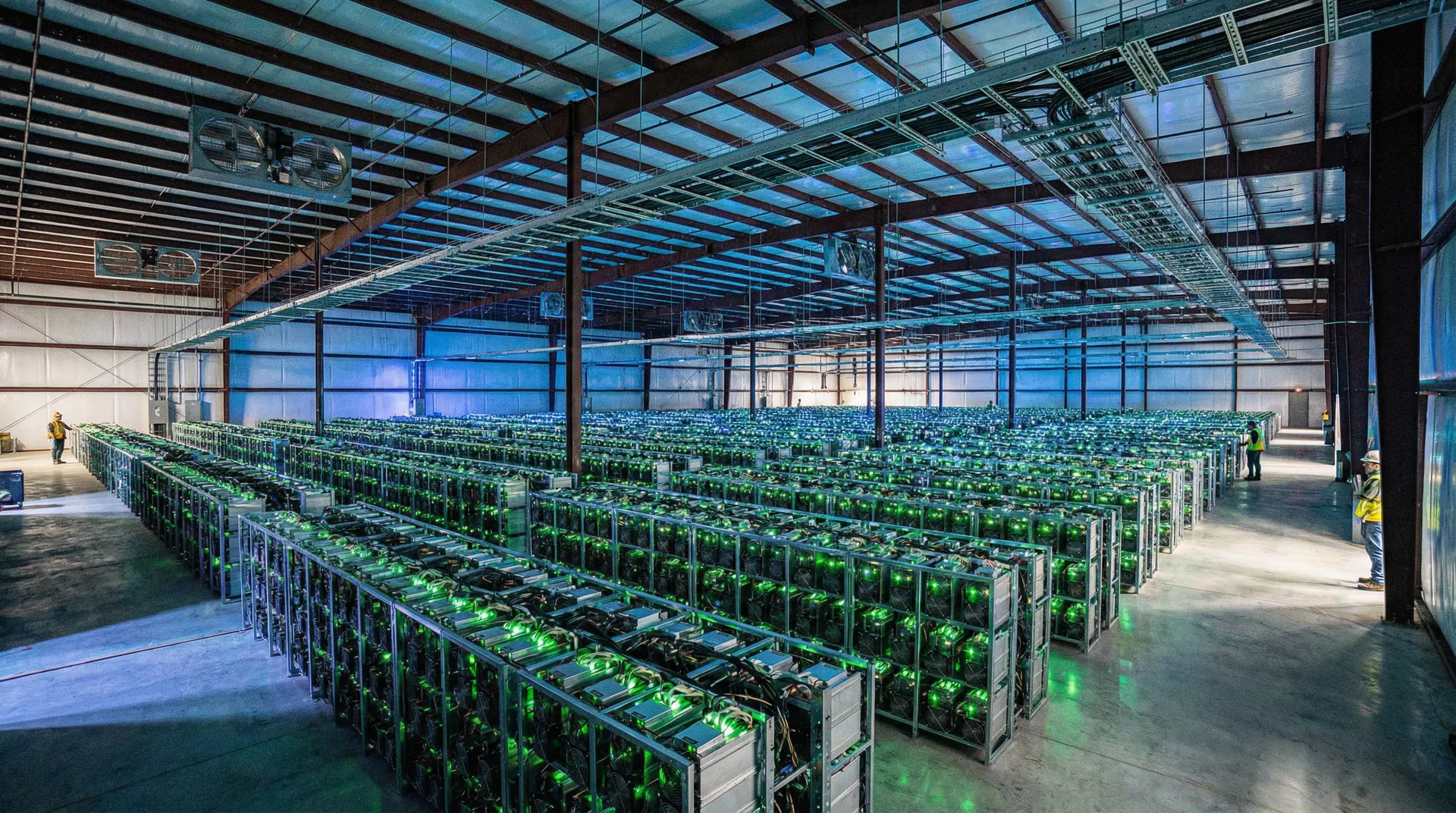
To truly understand a Bitcoin mining operation, you have to leave the world of digital abstraction and step into the physical reality of a modern data center. Imagine a vast, windowless warehouse, the size of a football field, located in a remote, windswept corner of West Texas or the barren plains of Kazakhstan. The air outside is still, but as you approach the building, a low hum becomes a deafening roar—the sound of tens of thousands of computers and their cooling fans, all running at maximum capacity, 24 hours a day.
Inside, the space is a cathedral of computation. Long, perfectly straight aisles are lined with towering racks, each packed with dozens of shoebox-sized ASIC miners. These are not the sleek, consumer-grade electronics you find at Best Buy; they are raw, industrial machines, stripped down to their bare essentials. Each one is a dense brick of circuit boards and heat sinks, connected by a thicket of power and data cables. The air is hot and dry, a constant byproduct of the immense computational work being performed. The aisles are a torrent of hot air, expelled from the back of the miners and channeled towards massive industrial cooling systems.
Technicians in ear protection patrol the aisles, their faces illuminated by the glow of their tablets as they monitor the health of the machines. A single red light on a miner can indicate a fault that needs immediate attention. Every second of downtime is lost revenue. The scale is immense, and the operation is a finely tuned logistical dance. Pallets of new miners arrive on trucks, ready to be unboxed, configured, and racked. Failed units are pulled, repaired, or replaced. The entire facility is a living, breathing organism, dedicated to a single purpose: converting electricity into hash rate.
This is the physical manifestation of the Bitcoin network—a global, decentralized supercomputer, built not by a single company, but by a distributed network of entrepreneurs and investors, all competing and collaborating to secure the world’s first digital currency.
XIII. The Central Dilemma
The central dilemma for the modern Bitcoin miner is the tension between specialization and diversification. For years, the path to success was clear: specialize in Bitcoin mining, optimize for operational efficiency, and ride the waves of the crypto market. The most successful miners were those who went all-in on Bitcoin, building their entire business around the production of this single digital commodity.
However, the 2024 halving and the rise of AI have created a powerful new incentive to diversify. The economics of AI/HPC hosting are, in many cases, more attractive than Bitcoin mining. The revenue is more stable, the margins can be higher, and the demand is driven by a long-term technological trend that is independent of the crypto markets. This has created a fundamental strategic choice for miners:
- •Remain a Bitcoin Pure-Play: Double down on Bitcoin mining, believing that the long-term appreciation of Bitcoin will outweigh the stability of hosting revenue. This is a high-risk, high-reward strategy that maintains a direct, leveraged exposure to the crypto market. Companies that pursue this path are making a clear bet on the future of Bitcoin as a global monetary asset.
- •Become a Diversified Infrastructure Provider: Pivot towards a hybrid model, allocating capital and infrastructure to both Bitcoin mining and AI/HPC hosting. This strategy reduces risk and creates a more resilient, predictable business. However, it also dilutes the exposure to Bitcoin’s potential upside and requires a broader set of corporate capabilities.
This is not just a financial decision; it is a question of identity. Is a Bitcoin mining company a financial asset producer, a specialized energy company, or a general-purpose computational infrastructure provider? The answer to this question will determine the future of the industry. The market is currently rewarding the diversifiers, but a major bull run in Bitcoin could quickly shift the calculus back in favor of the pure-plays. Navigating this dilemma is the core challenge for every CEO and investor in the space.
XIV. The Next Frontier
The next frontier for the Bitcoin mining industry is the full-scale integration of its operations with the global energy and computing markets. The pivot to AI is just the first step in a broader transformation. The miners of the future will not be just Bitcoin producers; they will be sophisticated, technology-driven energy and infrastructure companies. Several key trends will define this next chapter:
1. The Rise of the “Compute-as-a-Commodity” Model: Miners will increasingly abstract their underlying infrastructure, selling computational power (whether for hashing or for AI) as a fungible commodity. This will lead to the development of new financial products, such as hash rate futures and options, that allow for more sophisticated hedging and risk management.
2. Deeper Integration with Energy Grids: The relationship between miners and energy grids will become more symbiotic. Miners will not just be consumers of energy; they will be active participants in grid management, providing a range of ancillary services like demand response, frequency regulation, and grid balancing. This will create new revenue streams and further solidify the industry’s role as a critical piece of energy infrastructure.
3. The Industrialization of Heat-Capture: The waste heat generated by miners is a valuable byproduct that is currently underutilized. The next frontier will see the large-scale deployment of heat-capture technologies, where the thermal energy from mining operations is used to heat greenhouses, residential buildings, and industrial processes. This will create another new revenue stream and dramatically improve the overall energy efficiency of the mining process.
4. The Emergence of Decentralized AI: Just as Bitcoin created a decentralized monetary network, a similar movement is emerging in the world of AI. The high cost and centralized control of AI development by a few large tech companies is creating demand for decentralized alternatives. Bitcoin miners, with their global network of distributed data centers, are perfectly positioned to provide the infrastructure for this new wave of decentralized AI, creating a powerful synergy between the two most important technological trends of our time.
XV. Lessons from History
The evolution of the Bitcoin mining industry is not without historical precedent. By examining the development of other capital-intensive, commodity-producing industries, we can gain valuable insights into the potential future of mining.
1. The Oil and Gas Industry: The early days of the oil industry were a chaotic, speculative gold rush, much like the early days of Bitcoin mining. Wildcatters drilled for oil with little scientific rigor, and fortunes were made and lost overnight. However, the industry eventually consolidated and matured, dominated by large, vertically integrated players who controlled the entire supply chain, from exploration and production to refining and distribution. Similarly, the Bitcoin mining industry is consolidating, with large, publicly traded companies pursuing vertical integration by owning their own power generation and data center infrastructure.
2. The Gold Mining Industry: The parallels between Bitcoin and gold are well-known, and the same is true for their respective mining industries. The gold rushes of the 19th century were characterized by individual prospectors with picks and shovels. Over time, the industry industrialized, with large mining corporations using sophisticated machinery to extract gold from the earth. The most successful gold miners were not just those who found the most gold, but those who were the most efficient at moving rock and earth. Similarly, the most successful Bitcoin miners are those who are the most efficient at converting electricity into hash rate.
3. The Data Center and Cloud Computing Industry: The pivot from Bitcoin mining to AI/HPC hosting is a classic example of a company leveraging its existing infrastructure to enter a new, adjacent market. The data center industry itself followed a similar path. Early data centers were built by individual companies to house their own servers. Over time, a new industry of specialized data center providers emerged, offering co-location and cloud computing services. These companies, like Equinix and Digital Realty Trust, became the landlords of the digital world. Bitcoin miners are now following in their footsteps, transforming themselves from producers of a single digital commodity into providers of general-purpose computational infrastructure.
XVI. The Risks
Despite the compelling investment thesis, the Bitcoin mining industry is not without significant risks. Investors must be clear-eyed about the challenges and uncertainties that could impact the sector’s profitability and long-term viability.
- •Bitcoin Price Volatility: This remains the single biggest risk for the industry. A prolonged bear market in Bitcoin would put severe pressure on miners’ revenues and could lead to bankruptcies and consolidation, as seen in previous cycles. While the pivot to AI hosting provides a hedge, the majority of the industry’s revenue is still tied to the price of Bitcoin.
- •Regulatory Risk: The legal and regulatory landscape for cryptocurrency and mining is still evolving. A crackdown by a major government, particularly the United States, could have a devastating impact on the industry. The risk of new taxes, environmental regulations, or outright bans remains a persistent threat.
- •Energy Price Volatility: Electricity is the primary operating cost for miners. A sharp increase in energy prices, driven by geopolitical events or changes in local energy markets, could quickly erase profitability. While many miners have long-term PPAs, they are not completely immune to fluctuations in the broader energy market.
- •Technological Obsolescence: The Bitcoin mining hardware industry is characterized by rapid innovation. New, more efficient ASIC miners are constantly being developed, rendering older models obsolete. Miners must continually invest in the latest hardware to remain competitive, a capital-intensive process that requires significant foresight and financial planning.
- •Competition from Big Tech in AI Hosting: While the AI/HPC hosting market presents a massive opportunity, Bitcoin miners will face stiff competition from established cloud providers like Amazon Web Services, Microsoft Azure, and Google Cloud. These companies have deep pockets, long-standing customer relationships, and a global network of data centers. Miners will need to differentiate themselves on cost, speed, or specialization to compete effectively.
XVII. The Alternative Fortune Verdict
Bitcoin mining has undergone a profound transformation. What was once a speculative, high-risk bet on the future price of a single digital asset has matured into a sophisticated, capital-intensive infrastructure play. The industry’s pivot from pure-play crypto production to diversified computational infrastructure provider is not just a defensive move to survive the 2024 halving; it is a strategic evolution that unlocks a massive new addressable market and fundamentally enhances the sector’s long-term investment case.
The core of the thesis is no longer about whether Bitcoin will go to $1 million. It is about the durable value of the infrastructure that underpins the digital world. The demand for computational power, whether for securing a global monetary network or for training the next generation of artificial intelligence, is one of the most powerful secular trends of our time. Bitcoin miners are at the epicenter of this trend, possessing the infrastructure, the energy expertise, and the operational grit to meet this demand.
However, this is not a risk-free investment. The industry is still subject to the volatility of the crypto markets, the whims of regulators, and the relentless pace of technological change. The winners will be those who can navigate this complex landscape with a mastery of both energy markets and capital markets. They will be the ones who can secure the cheapest power, deploy the most efficient hardware, and build the most resilient, diversified business models.
For investors with a long-term horizon and an appetite for risk, the Bitcoin mining sector offers a unique and compelling opportunity. It is a chance to invest in the picks and shovels of the digital age, the core infrastructure that will power the next wave of technological innovation. But as with any frontier, due diligence is paramount.
Due Diligence Questions for Investors:
- •Energy Strategy: What is the company’s all-in cost of power? Do they have long-term, fixed-rate PPAs? Are they diversified across different energy sources and geographic regions?
- •Hardware Fleet: What is the average energy efficiency of their mining fleet? What is their strategy for upgrading to the latest generation of hardware?
- •AI/HPC Strategy: Do they have a credible plan to diversify into AI/HPC hosting? Have they secured any contracts with AI clients? What is the potential revenue and margin from this business?
- •Balance Sheet and Capital Structure: How much debt do they have? Do they have sufficient liquidity to withstand a prolonged bear market? How much of their mined Bitcoin do they hold on their balance sheet?
- •Management Team: Does the management team have a track record of operational excellence and disciplined capital allocation? Do they have experience in both the energy and technology sectors?