The 60-Second Version
For those who equate fine wine with Bordeaux, it’s time to look east. Welcome to Burgundy, the asset class where rarity is the currency and a single bottle can fetch more than a new car. This isn’t just about fermented grapes; it’s about owning a piece of a near-mythical terroir, a microscopic plot of land that produces the world’s most sought-after Pinot Noir and Chardonnay. The Burgundy market is dominated by a handful of legendary producers, with names like Domaine de la Romanée-Conti (DRC), Leroy, and Rousseau whispered in reverent tones. A bottle of DRC’s Romanée-Conti Grand Cru averages over $20,000, a testament to its extreme scarcity and iconic status. The Liv-ex Burgundy 150 index, a key benchmark, has shown a 9.2% return over the past five years, even after a significant market correction in 2023-2024. That correction has created a potential entry point for savvy investors, with the market showing signs of recovery in early 2026. The investment case is simple: demand, driven by a growing global elite, far outstrips a supply that is structurally, and often frustratingly, small. But be warned: this is a market of breathtaking volatility, where climate change poses an existential threat to the delicate Pinot Noir grape. Investing here requires deep knowledge, patience, and a healthy dose of courage. This is Burgundy: the wine market’s most exclusive—and volatile—asset class.
I. What Burgundy Wine Investing Actually Is
Investing in Burgundy wine is fundamentally different from investing in stocks, bonds, or even other collectibles. You are not buying a claim on future cash flows, but rather a tangible, perishable, and ultimately consumable asset whose value is derived from a complex interplay of terroir, producer reputation, vintage, and extreme scarcity. At its core, you are buying bottled liquid history, a direct product of a specific patch of earth, in a specific year, crafted by a specific set of hands. The two grape varietals that reign supreme here are Pinot Noir for reds and Chardonnay for whites. Unlike Bordeaux, where wines are typically blends from large estates, Burgundy is a mosaic of tiny, family-owned domaines, each producing a portfolio of wines from minuscule plots, known as climats. This fragmentation, a result of Napoleonic inheritance laws, is the source of both Burgundy’s complexity and its investment appeal. A single Grand Cru vineyard like Clos de Vougeot, for instance, is divided among more than 80 different owners.
So, what are you actually buying? You are acquiring a claim on a tiny fraction of the annual output of one of the world’s most revered wine regions. The investment thesis is built on the principle of capital appreciation. As a bottle of fine Burgundy ages, it not only (theoretically) improves in quality, but it also becomes rarer as other bottles of the same vintage are consumed. This dwindling supply, coupled with ever-increasing global demand from high-net-worth individuals, creates the potential for significant price appreciation over time. Returns are not generated through dividends or yield, but through the eventual sale of the wine to another collector, investor, or consumer at a higher price. It is a long-term, illiquid investment that requires patience and expertise.
At the heart of Burgundy is the concept of terroir, a French term that encompasses the entire natural environment of a vineyard, including its soil, topography, climate, and even the local yeast cultures. The belief in Burgundy is that each specific vineyard site, or climat, has a unique and identifiable character that is expressed in the wine. This is why a wine from one side of a dirt track can be classified as a Grand Cru and command a price in the thousands of dollars, while a wine from the other side is a mere Premier Cru and sells for a fraction of the price. The classification system in Burgundy is a formal recognition of this hierarchy of terroir. There are four main levels:
- •Grand Cru: These are the best of the best, the top 2% of vineyards in Burgundy. There are 33 Grand Crus in the Côte d’Or, and they are the primary focus of investment-grade Burgundy. The label will simply state the name of the vineyard, for example, “Montrachet” or “Chambertin.”
- •Premier Cru: These are excellent vineyards, but a step below Grand Cru. They account for about 12% of production. The label will state the name of the village, followed by the name of the vineyard, for example, “Gevrey-Chambertin 1er Cru Les Cazetiers.”
- •Village Wines: These wines come from vineyards within a specific village that are not classified as Grand or Premier Cru. They can offer excellent value and a good introduction to the style of a particular village. The label will state the name of the village, for example, “Vosne-Romanée.”
- •Regional Wines: These are the most basic wines of Burgundy, and can be made from grapes grown anywhere in the region. The label will state “Bourgogne Rouge” or “Bourgogne Blanc.”
For an investor, the focus is almost exclusively on the Grand and Premier Cru wines from the top producers. These are the wines with the proven track record of aging and appreciation.
The history of winemaking in Burgundy is a long and storied one, dating back to the Romans. However, it was the Catholic monks, particularly the Benedictines and Cistercians, who laid the groundwork for the region’s modern reputation. From the Middle Ages onwards, the monks meticulously studied the vineyards, identifying the plots that consistently produced the best wines. They were the first to understand the importance of terroir, and they are responsible for delineating many of the famous vineyards that are still revered today, such as Clos de Vougeot. The French Revolution led to the seizure and sale of the church’s vineyards, and the Napoleonic Code of inheritance, which required estates to be divided equally among heirs, led to the fragmentation of the vineyards into the tiny parcels we see today. This is in stark contrast to Bordeaux, where the great estates, or châteaux, have remained largely intact for centuries.
The concept of climats is so central to Burgundy’s identity that in 2015, the climats and terroirs of Burgundy were inscribed on the UNESCO World Heritage list. This was a recognition of the unique and irreplaceable cultural and historical significance of the region’s vineyards. The UNESCO designation is not just a marketing tool; it is a commitment to protecting and preserving this precious landscape for future generations.
II. The Market
The market for Burgundy is a paradox: it is both a niche segment of the global fine wine market and a dominant force in the world of wine investment. While Burgundy accounts for a mere 0.5% of global wine production, it commands a disproportionate share of the auction market and media attention. The total global fine wine market was estimated to be around €30 billion in 2024. While specific figures for the Burgundy market are elusive, export revenue gives us a sense of scale. In 2024, Burgundy’s export revenue surpassed €1.6 billion, a staggering figure given the region’s small production. This highlights the intensely concentrated value within this small region. The market is characterized by extreme price sensitivity to supply fluctuations. A difficult vintage with low yields, such as 2021, can lead to immediate price spikes, while a bountiful harvest can soften prices, at least for a time.
The Liv-ex Burgundy 150 is the industry’s leading benchmark for tracking the performance of the most actively traded Burgundy wines on the secondary market. The index, which is calculated monthly, comprises 15 of the most sought-after red and white Burgundies, including six wines from the legendary Domaine de la Romanée-Conti. The performance of this index is a key indicator of the health of the Burgundy market. After a decade of spectacular growth, the index peaked in late 2022, before entering a period of correction that saw it fall by over 28% by the spring of 2025. This downturn, while significant, should be seen in the context of the market’s long-term performance. As of early 2026, the index is still up over 9% over the past five years and has more than doubled over the past decade, demonstrating the asset class’s long-term resilience.
The auction market is another key barometer of the health of the Burgundy market. The world’s major auction houses, including Sotheby’s, Christie’s, and Acker Merrall & Condit, all hold regular fine wine auctions in which Burgundy plays a starring role. These auctions are where many of the world’s rarest and most expensive wines change hands, and the results are closely watched by collectors and investors. A record-breaking price for a bottle of DRC at a Hong Kong auction can send a ripple of excitement through the entire market, while a series of disappointing results can signal a cooling of demand.
Unlike Bordeaux, where the scores of a few key critics, most notably Robert Parker, have historically had a huge impact on prices, the Burgundy market is more fragmented and less reliant on a single voice. That is not to say that critics are not important. The opinions of influential Burgundy critics, such as Allen Meadows of Burghound, Stephen Tanzer, and Neal Martin, can certainly impact the demand for a particular wine or producer. A high score from a respected critic can help to elevate the status of a lesser-known domaine and create a new collectible. However, the top producers in Burgundy have such a long and established track record of excellence that they are largely immune to the whims of any single critic. Their reputation is built on decades, and in some cases centuries, of producing exceptional wines, and their allocation lists are so oversubscribed that they could sell their entire production many times over, regardless of what the critics say.
| Year | Milestone | Significance |
|---|---|---|
| 1985 | The “Vintage of the Century” | A legendary vintage that produced exceptional wines and drew global attention to Burgundy. |
| 1990s | Rise of the “Cult” Domaines | Producers like Henri Jayer and Lalou Bize-Leroy (Domaine Leroy) gain international fame, and their wines become highly sought-after collectibles. |
| 2008 | Global Financial Crisis | The fine wine market, including Burgundy, experiences a temporary downturn, but recovers relatively quickly. |
| 2011-2012 | Asian Market Boom | A surge in demand from China and other Asian markets drives a rapid escalation in prices for top Burgundy. |
| 2022-2025 | The Great Correction | After a decade of unprecedented growth, the Burgundy market experiences a significant price correction, with the Liv-ex Burgundy 150 index falling by over 28%. |
| 2026 | Tentative Recovery | The market begins to show signs of stabilization and a potential recovery, with buyers returning to blue-chip producers. |
III. The Demand Drivers
The relentless upward pressure on Burgundy prices is a classic case of demand consistently outstripping a severely constrained supply. Several key factors are fueling this insatiable appetite:
- •
The Rise of the Global Elite: The primary driver is the expanding class of global high-net-worth and ultra-high-net-worth individuals. As wealth grows in both established and emerging economies, so does the pool of collectors and consumers who can afford, and desire, the very best. For this demographic, a case of DRC is not just a beverage; it is a status symbol, a Veblen good whose desirability increases with its price.
- •
The Asian Market’s Shift in Taste: While Bordeaux was the initial beneficiary of Asia’s fine wine boom, sophisticated collectors in markets like Hong Kong, Singapore, and, increasingly, mainland China have developed a deep appreciation for Burgundy’s nuanced, terroir-driven wines. This shift has funneled a massive new wave of capital into an already tight market. The demand is not just for the top names but is also trickling down to Premier Cru and even village-level wines from reputable producers.
- •
The Scarcity Principle: This is the bedrock of Burgundy’s value. Production is minuscule compared to other major wine regions. The entire Grand Cru of Romanée-Conti is a mere 1.8 hectares, producing only a few thousand bottles a year for the entire world. This is not artificial scarcity; it is a structural reality of the region’s geography and history. As each vintage is consumed, the remaining bottles become rarer and, consequently, more valuable.
- •
The Knowledge-Driven ‘Connoisseur’ Culture: Unlike other luxury goods, appreciating Burgundy requires a certain level of knowledge and sophistication. This intellectual barrier to entry creates a dedicated and passionate collector base that is less susceptible to fleeting trends. The pursuit of rare and exceptional bottles becomes a hobby, a passion, and an obsession for many, further fueling demand.
- •
The Rise of White Burgundy: While red Burgundy has traditionally been the star of the show, the demand for top white Burgundy has been growing at a rapid pace. The best Chardonnays from producers like Coche-Dury, Domaine Leflaive, and Domaine Roulot are now among the most expensive and sought-after white wines in the world. This has broadened the appeal of Burgundy as an asset class and created a new area of opportunity for investors.
IV. The Players
The Burgundy ecosystem is a complex web of small growers, powerful négociants, and influential merchants. Understanding the roles of these different players is crucial for any investor. The lines between these categories can sometimes be blurry. Many top domaines also have a small négociant business on the side, and many large négociants have acquired significant vineyard holdings over the years, making them major producers in their own right.
- •
Domaines (Producers): These are the growers who own their own vineyards and make wine from their own grapes. They are the heart and soul of Burgundy, and the most sought-after wines typically come from top domaines. The most famous domaines have a cult-like following and their wines are allocated to a select list of clients.
- •
Négociants: These are merchants who buy grapes, must (unfermented grape juice), or finished wine from smaller growers, and then age, bottle, and sell the wine under their own label. Historically, négociants were the dominant force in Burgundy, and many, like Louis Jadot and Joseph Drouhin, have become large, respected producers in their own right, often owning significant vineyard holdings themselves.
- •
Merchants and Importers: These are the companies that buy wine from both domaines and négociants and sell it to private clients, restaurants, and retailers around the world. They play a crucial role in the distribution and marketing of Burgundy wines.
| Name | Type | AUM/Scale | Notable |
|---|---|---|---|
| Domaine de la Romanée-Conti (DRC) | Producer | Tiny (approx. 28 ha) | Widely considered the pinnacle of Burgundy. Co-owned by the de Villaine and Leroy families. Its Romanée-Conti Grand Cru is one of the world's most expensive wines. |
| Domaine Leroy | Producer | Small (approx. 23 ha) | Owned by the legendary Lalou Bize-Leroy. Known for its biodynamic viticulture and exceptionally pure, concentrated wines. Prices often rival or exceed those of DRC. |
| Domaine Armand Rousseau | Producer | Small (approx. 15 ha) | A benchmark producer in Gevrey-Chambertin, known for its elegant and long-lived wines. |
| Domaine Coche-Dury | Producer | Tiny (approx. 9 ha) | A cult producer of white Burgundy from Meursault. His wines are renowned for their power, complexity, and incredible aging potential. |
| Maison Louis Jadot | Négociant | Large | One of the largest and most respected négociants, with extensive vineyard holdings. Produces a wide range of wines from basic Bourgogne to Grand Crus. |
| Maison Joseph Drouhin | Négociant | Large | Another major négociant with a long history and significant vineyard ownership. Known for its elegant and consistent style. |
| Berry Bros. & Rudd | Merchant | Large | The UK's oldest wine and spirit merchant, with a strong focus on Burgundy. A key player in the en primeur market. |
| Corney & Barrow | Merchant | Medium | The exclusive UK agent for Domaine de la Romanée-Conti, giving them a unique position in the market. |
V. Geography
The geography of Burgundy is the key to understanding its wines. The region is a complex mosaic of tiny vineyards, each with its own unique terroir. The heart of Burgundy is the Côte d’Or, a narrow, 30-mile-long limestone escarpment that is home to all of the region’s red Grand Crus and all but one of its white Grand Crus. The Côte d’Or is further divided into two sub-regions: the Côte de Nuits in the north, which is famous for its powerful, long-lived Pinot Noirs, and the Côte de Beaune in the south, which is renowned for its rich, complex Chardonnays.
| Region | Key Villages | Primary Grape | Investment Focus |
|---|---|---|---|
| Côte de Nuits | Gevrey-Chambertin, Morey-St-Denis, Chambolle-Musigny, Vougeot, Vosne-Romanée, Nuits-St-Georges | Pinot Noir | The world's most expensive and sought-after red wines. Grand Crus are the ultimate prize. |
| Côte de Beaune | Aloxe-Corton, Beaune, Pommard, Volnay, Meursault, Puligny-Montrachet, Chassagne-Montrachet | Chardonnay & Pinot Noir | Home to the world's greatest dry white wines, as well as some exceptional reds. |
| Chablis | Chablis | Chardonnay | Crisp, mineral-driven white wines. Grand Cru and top Premier Cru wines are gaining investor attention. |
| Côte Chalonnaise | Mercurey, Givry, Rully, Montagny | Pinot Noir & Chardonnay | A source of high-quality, value-oriented red and white Burgundy. A region to watch. |
| Mâconnais | Mâcon, Pouilly-Fuissé, Saint-Véran | Chardonnay | Best known for affordable white wines, but the top wines of Pouilly-Fuissé are world-class. |
Beyond the Côte d’Or, there are several other important sub-regions in Burgundy, each with its own distinct character and investment potential:
- •
Chablis: Located to the north of the Côte d’Or, Chablis is a white wine region that is famous for its crisp, mineral-driven Chardonnays. The wines of Chablis are fermented and aged in stainless steel, which gives them a completely different character to the oak-aged Chardonnays of the Côte de Beaune. While Chablis has not historically been a major focus for investors, the best Grand Cru and Premier Cru wines from top producers are starting to attract attention.
- •
The Côte Chalonnaise: Located to the south of the Côte de Beaune, the Côte Chalonnaise is a less-prestigious but increasingly important region that produces both red and white wines. The best villages in the Côte Chalonnaise, such as Mercurey and Givry, are producing wines that can rival those of the Côte d’Or at a fraction of the price. This is a region to watch for savvy investors looking for the next big thing.
- •
The Mâconnais: Located at the southern end of Burgundy, the Mâconnais is a large region that is best known for producing affordable, easy-drinking white wines. However, the region is also home to the prestigious appellation of Pouilly-Fuissé, which is capable of producing world-class Chardonnays that can age for decades. The recent elevation of the best vineyards in Pouilly-Fuissé to Premier Cru status is a sign of the growing recognition of this underrated region.
Burgundy is a long, narrow wine region in eastern France, stretching from just south of Dijon down to the area around Lyon. For investment purposes, the focus is almost exclusively on the northern half of this region. The concept of terroir is everything in Burgundy, and the region’s geography is a complex patchwork of microclimates and soil types. The most important area is the Côte d’Or, or “Golden Slope,” a limestone escarpment that is home to all of the region’s red Grand Crus and all but one of its white Grand Crus.
| Region | Key Appellations | Primary Grape | Characteristics |
|---|---|---|---|
| Chablis | Chablis Grand Cru, Chablis Premier Cru | Chardonnay | The northernmost outpost of Burgundy, known for its crisp, mineral-driven Chardonnays with high acidity, often described as having a "flinty" character. Geographically separate from the rest of Burgundy. |
| Côte de Nuits | Gevrey-Chambertin, Vosne-Romanée, Chambolle-Musigny, Nuits-Saint-Georges | Pinot Noir | The northern half of the Côte d'Or, and the source of the world's most famous and expensive red wines. The wines are known for their structure, complexity, and aging potential. |
| Côte de Beaune | Meursault, Puligny-Montrachet, Chassagne-Montrachet, Corton-Charlemagne | Chardonnay (primarily), Pinot Noir | The southern half of the Côte d'Or, home to the world's greatest dry white wines. The red wines are generally softer and more approachable than those from the Côte de Nuits. |
| Côte Chalonnaise | Mercurey, Givry, Rully | Pinot Noir, Chardonnay | Located just south of the Côte d'Or, this region offers good value and is a source of high-quality, but less prestigious, red and white wines. |
| Mâconnais | Pouilly-Fuissé, Saint-Véran | Chardonnay | The southernmost major region of Burgundy, known for producing ripe, fruity, and often unoaked Chardonnays that are generally intended for early consumption. |
VI. How to Actually Invest
Investing in Burgundy is not as simple as buying a few bottles at your local wine shop. Access to the most desirable wines is tightly controlled, and proper storage is essential to protect your investment. Here are the primary ways to gain exposure to this asset class:
| Vehicle | Min Investment | Liquidity | Expected Return | Risk Level |
|---|---|---|---|---|
| Physical Bottles (via Merchants) | $10,000+ | Very Low | 5-15% p.a. (long-term) | High |
| En Primeur (Futures) | $5,000+ | Very Low | 10-20%+ (if vintage appreciates) | Very High |
| Wine Investment Funds | $25,000+ | Low to Medium | 8-12% p.a. (net of fees) | Medium |
| Online Investment Platforms | $1,000+ | Low to Medium | 7-12% p.a. (net of fees) | Medium |
Here is a more detailed look at each of these investment vehicles:
- •
Physical Bottles (via Merchants): This is the traditional way to invest in wine. You work with a reputable wine merchant to purchase cases of wine, which are then stored in a professional, climate-controlled warehouse under your name. This gives you direct ownership of the wine, but it also requires a significant amount of capital and expertise. You are responsible for choosing the wines, tracking their value, and deciding when to sell.
- •
En Primeur (Futures): This involves buying wine while it is still in the barrel, before it has been bottled and released. This can be a way to secure highly allocated wines at a lower price, but it is also a high-risk strategy. You are essentially betting on the quality of the vintage and the future direction of the market. If the vintage turns out to be a dud, or the market cools, you could be left with a significant loss.
- •
Wine Investment Funds: These are professionally managed funds that pool money from multiple investors to buy a diversified portfolio of fine wines. This can be a good option for those who want exposure to the asset class but don’t have the time or expertise to manage their own portfolio. However, you will have to pay management fees, which will eat into your returns.
- •
Online Investment Platforms: A new generation of online platforms has emerged that allows investors to buy and sell fractional shares of individual bottles of wine. This has made wine investment more accessible to a wider range of investors, but it is important to do your due diligence and make sure you are using a reputable platform.
| Vehicle | Pros | Cons |
|---|---|---|
| Physical Bottles | Direct ownership, full control, potential for highest returns. | High capital requirement, requires expertise, illiquid, storage costs. |
| En Primeur | Access to rare wines, potential for high returns. | High risk, speculative, no guarantee of quality. |
| Wine Investment Funds | Professional management, diversification, easier access. | Management fees, less control, returns may be lower. |
| Online Investment Platforms | Low minimum investment, fractional ownership, easier to diversify. | Newer, less proven model, platform risk, potential for lower returns. |
VII. Unit Economics
To understand the potential returns and costs of a Burgundy investment, let’s break down the unit economics of a hypothetical single case (12 bottles) of a Premier Cru Burgundy from a well-regarded producer. We will assume the wine is purchased en primeur and held for 10 years.
| Cost/Revenue Item | Amount (per case) | Notes |
|---|---|---|
| En Primeur Purchase Price | $3,000 | This can vary dramatically, but is a realistic price for a good Premier Cru. |
| Insurance & Storage (10 years) | $600 | Assuming a cost of $5 per bottle per year for professional, climate-controlled storage. |
| Total Outlay | $3,600 | The total cash invested over the 10-year period. |
| Sale Price (Year 10) | $9,000 | Assuming a 200% appreciation over 10 years, which is a reasonable, albeit not guaranteed, expectation for a good vintage from a top producer. |
| Selling Fees (10%) | ($900) | A typical commission for selling through an auction house or merchant. |
| Net Sale Proceeds | $8,100 | The cash received after selling fees. |
| Net Profit | $4,500 | Net Sale Proceeds - Total Outlay. |
| Total Return on Investment (ROI) | 125% | ($4,500 / $3,600) * 100 |
| Annualized Return | 8.45% | A solid, but not spectacular, annualized return. The real money in Burgundy is made on the Grand Crus, where appreciation can be much higher. |
To illustrate the difference, let’s consider a hypothetical investment in a case of Grand Cru Burgundy:
| Cost/Revenue Item | Amount (per case) | Notes |
|---|---|---|
| En Primeur Purchase Price | $15,000 | A realistic price for a case of Grand Cru from a top producer (though not DRC or Leroy). |
| Insurance & Storage (10 years) | $600 | Assuming a cost of $5 per bottle per year. |
| Total Outlay | $15,600 | The total cash invested over the 10-year period. |
| Sale Price (Year 10) | $60,000 | Assuming a 300% appreciation over 10 years, a more aggressive but still plausible scenario for a top Grand Cru. |
| Selling Fees (10%) | ($6,000) | A typical commission for selling through an auction house or merchant. |
| Net Sale Proceeds | $54,000 | The cash received after selling fees. |
| Net Profit | $38,400 | Net Sale Proceeds - Total Outlay. |
| Total Return on Investment (ROI) | 246% | ($38,400 / $15,600) * 100 |
| Annualized Return | 13.2% | A much more compelling annualized return, demonstrating the power of investing at the top of the Burgundy pyramid. |
VIII. Macroeconomic Sensitivity
Like any asset class, Burgundy is not immune to the broader economic climate. However, its unique characteristics as a tangible, supply-constrained luxury good mean it behaves differently from traditional stocks and bonds. Here’s how it tends to perform across four major macroeconomic regimes:
| Regime | Impact | Historical Example |
|---|---|---|
| High Growth & Low Inflation (Goldilocks) | This is the ideal environment for Burgundy. Strong economic growth increases the wealth of the global elite, boosting demand. Low inflation and low interest rates make alternative assets like wine more attractive compared to cash or bonds. | The period from 2012 to 2019 saw a sustained bull run in the Burgundy market, driven by strong global economic growth and increasing demand from Asia. |
| Low Growth & High Inflation (Stagflation) | In this environment, Burgundy can act as a store of value and a hedge against inflation. While a slowing economy might temper the most speculative demand, the tangible nature of wine and its limited supply make it attractive to investors seeking to protect their capital from currency debasement. | During the high inflation period of the late 1970s, fine wine, while not as established an asset class, was seen as a tangible asset that held its value better than paper assets. |
| Low Growth & Low Inflation (Recession/Deflation) | This is a challenging environment for Burgundy. A recession can reduce the disposable income of even wealthy collectors, leading to a softening of demand and a potential fall in prices. The market becomes a "buyer's market," and liquidity can dry up. | The 2008 Global Financial Crisis saw a temporary but sharp drop in fine wine prices as collectors and investors de-risked their portfolios. However, the market recovered relatively quickly, demonstrating its underlying resilience. |
| High Growth & High Inflation | This is a mixed environment. High growth fuels demand, but high inflation and rising interest rates can make other asset classes more attractive and increase the cost of capital for wine investors. The market can become more volatile as these two forces compete. | The period from 2020 to 2022 saw a surge in fine wine prices, driven by a combination of pandemic-related fiscal stimulus (leading to inflation) and a surge in the wealth of the affluent. |
IX. Tax Considerations: A Global Overview
The tax treatment of wine investments can be as complex as the wines themselves, and varies significantly from one jurisdiction to another. It is essential to consult with a tax professional, but here is a general overview of how wine is typically taxed in several key markets.
| Country | Tax Treatment | Notes |
|---|---|---|
| United States | Wine is considered a "collectible" by the IRS. Profits from the sale of collectibles are taxed at a long-term capital gains rate of 28%, which is higher than the standard capital gains rate for stocks and other financial assets. | This higher tax rate is a significant consideration for US-based investors and can impact overall returns. |
| United Kingdom | Wine is considered a "chattel" (a tangible, movable asset). If a single bottle is sold for less than £6,000, any gain is exempt from Capital Gains Tax (CGT). For cases, the £6,000 limit applies to the case as a whole. | This "chattel exemption" makes the UK a very attractive location for wine investment, particularly for those investing in wines that are not expected to reach the £6,000 per-bottle threshold. |
| European Union | The tax treatment varies by member state. In France, for example, wine is generally subject to capital gains tax, but there are some exemptions for long-term holdings. | The EU is not a single market for tax purposes, and investors need to be aware of the specific rules in the country where they are resident. |
| Singapore | There is no capital gains tax in Singapore, making it an extremely tax-efficient location for wine investment. | The absence of capital gains tax has made Singapore a major hub for wine investment and storage in Asia. |
| UAE | There is no personal income tax or capital gains tax in the UAE, making it a completely tax-free environment for wine investment. | The UAE's tax-free status is a major draw for high-net-worth individuals and has contributed to the growth of the fine wine market in the region. |
| Australia | Wine is generally considered a collectible, and profits from its sale are subject to capital gains tax. However, there is an exemption for collectibles acquired for less than AUD $500. | The AUD $500 exemption is of limited use for serious Burgundy investors, as most investment-grade wines will exceed this value. |
X. Case Studies
To illustrate the potential returns—and the sheer scale of the numbers involved—in Burgundy investment, let’s look at two real-world case studies.
Case Study 1: The DRC Romanée-Conti 1990
A collector buys a 6-bottle case of Domaine de la Romanée-Conti, Romanée-Conti 1990 upon its release in 1993 for approximately $15,000. The 1990 vintage was highly acclaimed, but no one could have predicted the meteoric rise that was to come. The collector stores the wine in a professional, climate-controlled facility for the next three decades.
- •Initial Investment: $15,000
- •Holding Period: 30 years (1993-2023)
- •2023 Auction Result: In a 2023 Sotheby’s auction, a similar 6-bottle case of the same wine sold for $250,000.
- •Gross Profit: $235,000
- •Annualized Return: Approximately 9.8% over 30 years.
This case study highlights the incredible long-term capital appreciation potential of the very top Burgundy wines. It also demonstrates the importance of buying from a top producer in a great vintage and having the patience to hold the investment for the long term.
Case Study 2: The Leroy Musigny 2002
An investor with a strong relationship with a top London merchant is allocated a 3-bottle case of Domaine Leroy, Musigny Grand Cru 2002 for $12,000 in 2005. Domaine Leroy’s wines are notoriously difficult to acquire, and this allocation is a testament to the investor’s standing.
- •Initial Investment: $12,000
- •Holding Period: 18 years (2005-2023)
- •2023 Auction Result: A single bottle of the same wine sells for $40,000 at a Christie’s auction. The investor’s 3-bottle case is now worth $120,000.
- •Gross Profit: $108,000
- •Annualized Return: Approximately 13.5% over 18 years.
This case study illustrates the explosive returns that can be achieved with the rarest and most sought-after wines. It also underscores the importance of access and relationships in the Burgundy market. Without the initial allocation, this investment would not have been possible.
Case Study 3: The Coche-Dury Corton-Charlemagne 2010
An investor, recognizing the growing demand for high-end white Burgundy, purchases a single bottle of Domaine Coche-Dury, Corton-Charlemagne Grand Cru 2010 for $4,000 in 2015. Coche-Dury is a cult producer of white Burgundy, and his wines are notoriously difficult to find.
- •Initial Investment: $4,000
- •Holding Period: 8 years (2015-2023)
- •2023 Auction Result: A single bottle of the same wine sells for $15,000 at a Zachys auction.
- •Gross Profit: $11,000
- •Annualized Return: Approximately 18% over 8 years.
This case study highlights the incredible investment potential of top white Burgundy. It also demonstrates that significant returns can be achieved with a smaller initial investment, as long as you are able to acquire the right wines.
XI. The Core Constraint
The single biggest structural challenge facing the Burgundy asset class is its absolute and unchangeable scarcity. Unlike a company that can issue more stock, or a real estate developer who can build more apartments, you simply cannot create more Grand Cru Burgundy vineyard. The land is finite, and the boundaries of the appellations are strictly defined by law. The entire production of Romanée-Conti, the world’s most expensive wine, comes from a vineyard the size of a small city park. This fixed supply, in the face of ever-increasing global demand, is the fundamental driver of the market’s long-term appreciation. However, it is also its greatest vulnerability. Because the supply is so inelastic, any shift in demand can have a dramatic and immediate impact on prices, leading to the market’s notorious volatility. A sudden economic downturn, a change in collector tastes, or a new generation of wealthy buyers focusing on a different region could all lead to a rapid price correction. The core constraint is a double-edged sword: it is the source of Burgundy’s incredible returns, but also the source of its heart-stopping risk.
XII. Inside the Asset
To truly understand a Burgundy investment, you have to go beyond the numbers and the charts. You have to go to Burgundy. Imagine driving down the D974, the famous Route des Grands Crus. To your right, a gentle, sun-drenched slope rises, a patchwork of seemingly identical vineyards. But they are not identical. This is the Côte d’Or. That small plot of vines, no bigger than a suburban backyard, is Le Montrachet, the source of the world’s most coveted Chardonnay. A few hundred meters further, another, slightly larger plot: Romanée-Conti. There is no grand chateau, no imposing gate, just a simple stone cross and a sense of quiet reverence. The air smells of damp earth and money.
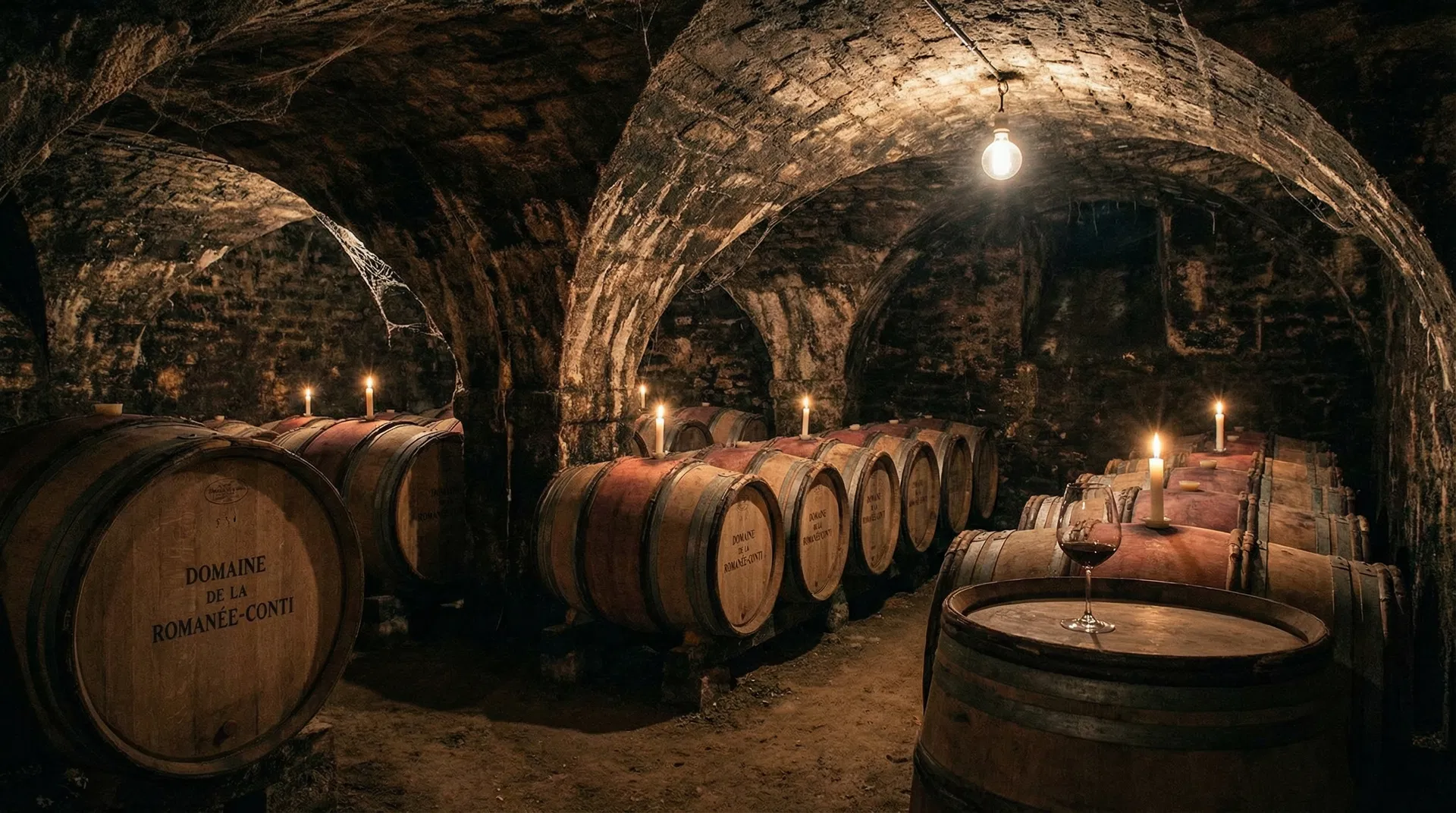
Now, step inside a cellar. It is cool and dark, the air thick with the sweet, earthy scent of aging wine. The walls are lined with barrels, each one containing a small fortune. The winemaker, a man whose family has been farming these vineyards for centuries, draws a sample from a barrel with a glass pipette, a verre de dégustation. The wine, a young Pinot Noir, is a brilliant, translucent ruby in the glass. The first sip is an explosion of flavor: wild strawberries, black cherries, a hint of spice, and a subtle, earthy minerality that speaks of the limestone soil in which the grapes were grown. The texture is silky, the finish long and complex. This is not just wine; it is a liquid expression of a specific place, a specific time, and a specific philosophy. It is a sensory experience that connects you to the land, to history, and to the passion of the people who make it. This is what you are buying. This is the asset.
XIII. The Central Dilemma
The central dilemma for any Burgundy investor is the profound, almost philosophical, tension between investment and consumption. Are you a collector or a drinker? An investor or a connoisseur? The truth is, to be successful in this market, you must be both, and that is a difficult balancing act.
On one hand, you have a financial asset that has demonstrated the potential for extraordinary returns. Your rational, investor brain tells you to hold, to wait for the perfect moment to sell, to maximize your profit. You track auction results, you monitor market trends, you worry about provenance and storage conditions. The wine is an entry on a spreadsheet, a position in your portfolio.
On the other hand, you have a bottle of what is arguably the most delicious and profound beverage on the planet. It is a living thing, evolving in the bottle, waiting for the perfect moment to be opened and shared. The hedonist in you, the wine lover, wants to experience it. You imagine the perfect meal, the perfect company, the perfect occasion. To drink a great Burgundy at its peak is to experience a kind of art, a fleeting moment of perfection that can never be replicated.
This is the paradox: the very act that realizes the wine’s ultimate purpose—consumption—destroys its financial value. Every bottle that is drunk makes the remaining ones rarer and more valuable, but if you are the one drinking it, your investment is, quite literally, liquidated. This creates a constant internal battle for the investor. Do you cash in on your investment, or do you cash in on the experience? There is no right answer, but it is the central dilemma that every Burgundy investor must confront.
XIV. The Next Frontier
Where does the world’s most traditional wine region go from here? The future of Burgundy will be shaped by a combination of adaptation, exploration, and technology.
- •
The Rise of the “Lesser” Appellations: As prices for Grand and Premier Cru Burgundy have soared into the stratosphere, savvy collectors and sommeliers are increasingly looking to the so-called “lesser” appellations for value. Villages like Marsannay, Fixin, and Santenay in the Côte d’Or, as well as the best sites in the Côte Chalonnaise (Givry, Mercurey) and the Mâconnais (Pouilly-Fuissé), are producing outstanding wines that offer a taste of Burgundy’s magic at a fraction of the price. The next frontier for many investors will be identifying the top producers in these emerging areas before the rest of the market catches on.
- •
The Ascendance of White Burgundy: While red Burgundy has historically dominated the headlines, the market for top white Burgundy is on a tear. The best Chardonnays from producers like Coche-Dury, Domaine Leflaive, and Domaine Roulot are now among the most expensive and sought-after white wines in the world. As climate change makes it more challenging to produce elegant Pinot Noir, some argue that Chardonnay, a more adaptable grape, is the future of Burgundy. The performance gap between red and white Burgundy has been closing, and many believe that top white Burgundy still has significant room for price appreciation.
- •
Technology in the Vineyard: While winemaking in Burgundy remains stubbornly traditional, a new generation of vignerons is cautiously embracing technology to combat the effects of climate change and improve quality. Drones are being used to monitor vineyard health, soil sensors provide real-time data on water stress, and advanced weather forecasting helps growers make better decisions about when to harvest. This is not about industrializing a craft, but about using technology to preserve the unique character of Burgundy’s terroir in a changing world.
XV. Lessons from History
While the Burgundy market may feel like a unique and unprecedented phenomenon, history is littered with examples of speculative bubbles in collectible assets. These historical parallels offer valuable lessons for today’s Burgundy investor.
- •
The Dutch Tulip Mania (1634-1637): The most famous speculative bubble in history, the Dutch tulip mania saw the price of a single tulip bulb reach astronomical levels, at its peak exceeding the price of a house in Amsterdam. The subsequent crash was swift and devastating. The lesson for Burgundy investors is that when an asset’s price becomes completely detached from its intrinsic value and is driven purely by speculation, a painful correction is inevitable. The question is not if, but when.
- •
The Japanese Art Market Bubble (1980s): In the 1980s, a booming Japanese economy and a soaring yen fueled a speculative frenzy in the art market. Japanese corporations and wealthy individuals paid record prices for Impressionist and Post-Impressionist masterpieces. When the Japanese economy crashed in the early 1990s, the art market collapsed along with it. The lesson here is the danger of a market that becomes overly reliant on a single source of demand. The diversification of the Burgundy market across multiple geographic regions is a source of strength, but the concentration of wealth in the hands of a global elite still poses a risk.
- •
The Bordeaux 2010 En Primeur Campaign: A more recent and relevant parallel is the Bordeaux 2010 en primeur campaign. After the highly acclaimed 2009 vintage, the 2010 vintage was released at even higher prices, driven by speculative demand from China. The market quickly cooled, and many investors who bought 2010 Bordeaux en primeur were left with significant losses. The lesson is that even in the fine wine market, trees do not grow to the sky. Chasing a hot market and buying at the peak of the hype cycle is a recipe for disaster. The 2022-2025 correction in the Burgundy market can be seen as a necessary and healthy recalibration after a period of unsustainable growth, arguably, irrational exuberance.
XVI. The Risks
Investing in Burgundy is not for the faint of heart. The potential for high returns is matched by a formidable array of risks that can wipe out an investment in the blink of an eye.
- •
Volatility: The Burgundy market is notoriously volatile. The same scarcity that drives prices to dizzying heights can also lead to breathtaking crashes. The 28% correction in the Liv-ex Burgundy 150 index between 2022 and 2025 is a stark reminder of this. This is a market driven by sentiment and momentum, and when the tide turns, it can turn with ferocious speed.
- •
Fraud and Counterfeiting: Where there is money, there is fraud, and the world of fine wine is no exception. The high prices and global demand for top Burgundy make it a prime target for counterfeiters. The case of Rudy Kurniawan, who was convicted in 2013 of counterfeiting millions of dollars’ worth of fine wine, sent a shockwave through the market. Provenance is everything, and investors must be vigilant about buying from reputable sources and keeping meticulous records.
- •
Storage and Provenance: Wine is a fragile asset. Improper storage can ruin a wine, and with it, its value. A single day in a hot delivery truck can be enough to cook a case of priceless Burgundy. Professional, climate-controlled storage is not a luxury; it is an absolute necessity. Equally important is provenance, the documented history of a wine’s ownership and storage. A wine with a perfect provenance, ideally stored in a professional facility since its release, will command a significant premium over a wine with a questionable history.
- •
Climate Change: This is the existential threat hanging over Burgundy. Pinot Noir is a notoriously fickle grape that is exquisitely sensitive to temperature. The rising temperatures and increasingly erratic weather patterns associated with climate change pose a direct threat to the delicate balance that makes great Burgundy possible. More frequent frosts, hailstorms, and heatwaves can devastate a vintage, and in the long term, could fundamentally alter the character of the region’s wines.
- •
Illiquidity: Fine wine is not a liquid asset. You cannot sell a case of Burgundy with the click of a mouse. Selling wine can be a slow and expensive process, often involving auction houses or specialized merchants who charge significant commissions. In a down market, liquidity can dry up completely, leaving investors unable to sell their holdings at any price.
XVII. The Alternative Fortune Verdict
So, what is the verdict on Burgundy? Is it a legitimate, albeit volatile, alternative asset class, or is it a speculative bubble waiting to burst? The answer, like a great Burgundy, is complex.
There is no denying the allure. The combination of extreme scarcity, fanatical global demand, and a rich history creates a powerful narrative that is hard to resist. The returns, as we have seen, can be extraordinary. For those with the capital, the knowledge, and the nerve, Burgundy offers a unique opportunity to invest in a tangible asset with a proven track record of long-term appreciation. The recent market correction has also created a more attractive entry point than we have seen in years. The smart money is quietly accumulating blue-chip producers at prices that were unthinkable just a few years ago.
However, the risks are just as real as the rewards. This is a market for connoisseurs, not amateurs. The volatility is not for the faint of heart, and the threat of climate change looms large. The high barrier to entry, both in terms of capital and knowledge, means that this is not an asset class for everyone.
Our verdict? Burgundy is a compelling, but high-risk, addition to a well-diversified alternative asset portfolio. It should not be your first, or only, alternative investment. But for those who have already built a solid foundation in other alternative assets and are looking for a new challenge, Burgundy offers a unique and potentially rewarding frontier. But before you take the plunge, here are a few questions to ask yourself:
- •Are you a wine lover? If you don’t have a genuine passion for wine, you will not have the patience or the motivation to navigate this complex market.
- •What is your time horizon? This is a long-term investment. If you are looking for a quick flip, look elsewhere.
- •How much can you afford to lose? Never invest more than you are prepared to lose. The Burgundy market can be brutal.
- •Do you have access to a reputable merchant or advisor? Access and expertise are everything in this market. Don’t try to go it alone.
- •Have you done your homework? Read everything you can get your hands on. Taste as much as you can afford. The more you know, the better your chances of success.