The 60-Second Version
The Rolex Daytona, a name that resonates with luxury, precision, and an unparalleled investment pedigree, is more than just a watch; it’s a globally recognized financial instrument. With a secondary market valued at over $20 billion, the Daytona has transcended its horological origins to become one of the most liquid and sought-after luxury assets in the world. This meteoric rise is not a matter of chance but a result of Rolex’s meticulous production discipline, a rich heritage intertwined with professional motorsports, and a cult-like following that has driven demand to unprecedented levels. Key references like the modern steel ceramic 116500LN, the transitional 116520, and the vintage 6239 “Paul Newman” have become asset classes in their own right, with the latter fetching millions at auction. The infamous “authorized dealer game” and the thriving grey market are testaments to the brand’s masterful control over supply, creating a Veblen good where desirability increases with price. While the market saw a bubble and subsequent correction in 2022, real-time pricing data from platforms like WatchCharts and Chrono24 demonstrates the Daytona’s remarkable resilience and continued upward trajectory. This article will dissect the anatomy of the world’s most liquid luxury asset, exploring the market dynamics, investment potential, and the cultural phenomenon that is the Rolex Daytona.
I. What Rolex Daytona Investing Actually Is
Investing in a Rolex Daytona is the practice of acquiring a specific model of Rolex’s premier chronograph watch with the primary intention of wealth preservation or capital appreciation. Unlike traditional investments such as stocks or bonds, a Rolex Daytona is a tangible, alternative asset. The return on investment is not generated through dividends or interest payments, but through the increase in the watch’s market value over time. This appreciation is driven by a confluence of factors including brand equity, controlled scarcity, historical significance, and aesthetic appeal. When you invest in a Rolex Daytona, you are not merely buying a timepiece; you are acquiring a stake in a brand that has masterfully cultivated an aura of exclusivity and desirability for over a century. The asset’s value is underpinned by Rolex’s unwavering commitment to quality, its iconic status in popular culture, and the consistently high demand from a global collector base. The investment thesis rests on the premise that the demand for these coveted timepieces will continue to outstrip the deliberately limited supply, leading to a sustained increase in their value on the secondary market. This is not a passive investment, however. It requires a deep understanding of the market, a keen eye for detail, and a network of trusted contacts. It is a game of patience, knowledge, and, to some extent, luck. The successful Daytona investor is not just a buyer of watches, but a student of the market, a connoisseur of the brand, and a participant in a global community of collectors and enthusiasts.
II. The Market
The market for Rolex Daytonas is a fascinating microcosm of the broader luxury watch market, which is projected to reach $66.92 billion in 2026 and grow at a CAGR of 3.52% through 2030 . Within this landscape, Rolex stands as a titan, commanding an estimated 30% market share of the entire Swiss watch industry . The Daytona, as Rolex’s flagship chronograph, represents a significant portion of this dominance, with a secondary market value that experts estimate to be in excess of $20 billion. This figure, while difficult to pin down with absolute precision, is a testament to the sheer volume and value of Daytonas trading hands outside of the authorized dealer network.
The Daytona’s market is characterized by a significant delta between its retail price and its secondary market value. This premium is a direct result of Rolex’s strategy of carefully managed scarcity. By producing fewer watches than the market demands, Rolex has created a perpetual state of desire, fueling the grey market where watches trade for multiples of their retail price. This dynamic was on full display during the 2022 market peak, where some modern Daytona models were trading at more than three times their retail value. While the market has since corrected, prices remain significantly above retail, demonstrating the asset’s underlying strength and desirability. The market is also highly segmented, with different models and references appealing to different types of buyers. The modern stainless steel models are the most popular and liquid, while the precious metal and gem-set models appeal to a wealthier and more niche clientele. The vintage market is a world unto itself, where rarity, condition, and provenance are the primary drivers of value. A vintage Daytona with a rare dial or a unique history can be worth many times more than a modern Daytona, but it also requires a much higher level of expertise to navigate.
| Year | Milestone | Significance |
|---|---|---|
| 1963 | Rolex launches the Cosmograph, reference 6239. | The birth of the iconic Daytona, initially designed for professional racing drivers. |
| 1965 | The "Daytona" name first appears on the dial. | Solidifies the connection to the Daytona International Speedway and motorsports. |
| 1988 | Introduction of the second series with the Zenith El Primero movement (ref. 16520). | The first automatic Daytona, a significant technological upgrade that sparked renewed interest. |
| 2000 | Rolex introduces its in-house caliber 4130 movement (ref. 116520). | A declaration of independence from third-party suppliers and a new era of technical mastery. |
| 2016 | Release of the steel Daytona with a ceramic bezel (ref. 116500LN). | The modern iteration that fueled the recent Daytona craze and sent secondary market prices soaring. |
| 2017 | Paul Newman's personal Rolex Daytona sells for a record $17.8 million. | Cemented the Daytona's status as a collectible of the highest order and a cultural icon. |
| 2022 | The luxury watch market experiences a bubble and correction. | A stress test for the Daytona market, which demonstrated its resilience and long-term value. |
| 2023 | Rolex introduces the updated reference 126500LN. | A subtle evolution of the iconic design, further stimulating demand and collector interest. |
III. The Demand Drivers
The Rolex Daytona’s extraordinary demand is not a product of a single factor, but rather a carefully orchestrated symphony of brand strategy, cultural resonance, and pure Veblen good economics. The following are the primary drivers that have propelled the Daytona to its current status as the world’s most coveted chronograph:
1. Brand Equity and The Power of the Crown: Rolex is the most powerful brand in the luxury watch industry, and arguably one of the most powerful luxury brands in the world. The Rolex crown is a universally recognized symbol of success, quality, and prestige. This brand equity, built over a century of relentless marketing and product excellence, provides a powerful tailwind for all Rolex models, but especially for the Daytona. The desire to own a Rolex is often the first step on a collector’s journey, and the Daytona, as the brand’s most aspirational steel sports model, is the ultimate prize. This is not just about the quality of the product, but about the story that Rolex tells. It is a story of adventure, exploration, and achievement, and it is a story that resonates with a global audience. The Daytona, with its deep roots in the world of motorsports, is a key chapter in this story, and it is a chapter that continues to captivate and inspire.
2. Controlled Scarcity and the Authorized Dealer Game: Rolex has mastered the art of supply and demand. The company produces an estimated one million watches per year, but this is still not enough to satisfy global demand. This scarcity is most acute for the stainless steel Daytona, which is notoriously difficult to acquire from an authorized dealer (AD). This has created the infamous “AD game,” where prospective buyers must cultivate a relationship with their local dealer, often by purchasing less desirable models, in the hopes of one day being offered a Daytona. This manufactured scarcity has the dual effect of making the watch more desirable and fueling the explosive growth of the secondary market. It is a brilliant, if frustrating, strategy, and it is a key reason why the Daytona has become such a powerful symbol of status and exclusivity.
3. The Paul Newman Effect and Cultural Resonance: The story of Paul Newman and his eponymous Daytona is a legend in the watch world. The actor and race car driver’s genuine love for his Daytona, a gift from his wife, transformed an initially slow-selling model into a cultural icon. The record-breaking auction of his personal watch for $17.8 million in 2017 catapulted the Daytona into the mainstream consciousness and solidified its status as a blue-chip collectible. This cultural resonance, reinforced by countless celebrity endorsements and appearances in film and television, has made the Daytona a symbol of cool and a must-have for the rich and famous. From the wrist of Jay-Z to the silver screen, the Daytona is a constant presence in popular culture, and this visibility has played a crucial role in driving its desirability.
4. Investment Potential and Financialization: In an era of low interest rates and volatile financial markets, tangible assets like luxury watches have become increasingly attractive to investors. The Rolex Daytona, with its proven track record of value appreciation, has emerged as a legitimate alternative asset class. This has led to the “financialization” of the Daytona, where a significant portion of demand is driven by investors and speculators seeking to profit from the watch’s rising value. This influx of investment capital has further fueled the Daytona’s price appreciation, creating a self-reinforcing cycle of demand and value creation. The rise of online marketplaces and social media has also made it easier than ever for investors to track prices, identify trends, and trade watches, further contributing to the financialization of the market.
IV. The Players
The Rolex Daytona market is a complex ecosystem with a diverse cast of players, each with their own role and influence. From the gatekeepers of new inventory to the high-stakes world of vintage auctions, understanding these players is crucial to navigating the Daytona market.
| Name | Type | AUM/Scale | Notable |
|---|---|---|---|
| Rolex SA | Manufacturer | Est. ~1M watches/year | The ultimate source of all new Daytonas, and the architect of the brand's scarcity model. A private, vertically integrated company that controls every aspect of the watchmaking process, from the casting of the gold alloys to the assembly of the movements. |
| Authorized Dealers (e.g., Tourneau/Bucherer, Mayors) | Retail | Global network of boutiques | The official gatekeepers of new Rolex watches, responsible for managing the infamous waiting lists. They are carefully selected by Rolex and are expected to uphold the brand's high standards of customer service and presentation. |
| Chrono24 | Grey Market (Marketplace) | >500,000 listings | The world's largest online marketplace for luxury watches, offering real-time price transparency and a platform for dealers and private sellers to connect with buyers. It has played a key role in the democratization of the watch market. |
| Bob's Watches | Grey Market (Dealer) | Est. >$100M revenue | A leading online dealer of pre-owned Rolex watches, known for its transparent pricing and market reports. It has built a reputation for trust and reliability in a market that is often opaque and unregulated. |
| Watchfinder & Co. | Grey Market (Dealer) | Subsidiary of Richemont | A major player in the pre-owned market, now owned by the luxury goods holding company Richemont. Its acquisition by Richemont is a sign of the growing importance of the pre-owned market. |
| Phillips in Association with Bacs & Russo | Auction House | >$200M in watch sales (2022) | The leading auction house for vintage and rare watches, responsible for the record-breaking Paul Newman sale. Led by the charismatic and influential Aurel Bacs, it has become the go-to auction house for the world's most important watches. |
| Sotheby's | Auction House | >$100M in watch sales (2022) | A major player in the global auction market, with a strong presence in the high-end watch segment. It has a long and storied history, and it has been responsible for some of the most important watch sales of all time. |
| Christie's | Auction House | >$100M in watch sales (2022) | A historic auction house with a dedicated watch department and a global network of collectors. It has a reputation for scholarship and expertise, and it is a major force in the vintage watch market. |
V. Geography
The demand for the Rolex Daytona is a global phenomenon, but its intensity and character vary significantly by region. The United States has long been the largest market for Swiss watches, and it remains the epicenter of Daytona demand. However, the rapid wealth creation in Asia, particularly in China and Hong Kong, has created a new and powerful collector base that is reshaping the global market.
| Region | Market Characteristics | Key Hubs |
|---|---|---|
| North America | The largest and most mature market for Rolex. Strong collector culture and a well-established network of dealers and auction houses. The US market is characterized by a strong appetite for steel sports models and a growing interest in vintage watches. | New York, Miami, Los Angeles, Dallas |
| Europe | A diverse market with a long history of watch appreciation. Strong demand in Western Europe, with a growing market in Eastern Europe. The European market is more traditional than the US market, with a greater emphasis on brand heritage and craftsmanship. | London, Geneva, Paris, Munich |
| Asia | The fastest-growing market for luxury watches. Dominated by Chinese consumers, both at home and abroad. The Asian market is characterized by a strong demand for status symbols and a growing interest in watch collecting as a hobby and an investment. | Hong Kong, Shanghai, Singapore, Tokyo, Dubai |
| Middle East | A wealthy market with a strong appetite for luxury goods. High demand for precious metal and gem-set Daytona models. The Middle Eastern market is a key market for Rolex's most exclusive and expensive creations. | Dubai, Abu Dhabi, Riyadh |
| Rest of World | Emerging markets with growing a collector base. These markets are still in the early stages of development, but they have the potential to become major players in the global watch market in the years to come. | Sydney, Melbourne, São Paulo, Mexico City |
VI. How to Actually Invest
Investing in a Rolex Daytona is not as simple as buying a stock or a bond. It requires a significant amount of capital, a deep understanding of the market, and a network of trusted contacts. There are several ways to gain exposure to this asset class, each with its own set of advantages and disadvantages.
| Vehicle | Min Investment | Liquidity | Expected Return | Risk Level |
|---|---|---|---|---|
| Outright Purchase (Grey Market) | ~$25,000+ | Moderate | 5-15% p.a. | High |
| Outright Purchase (Authorized Dealer) | ~$15,000+ | High | 10-20%+ p.a. | Low |
| Watch Funds | ~$250,000+ | Low | 10-20% p.a. | Moderate |
| Fractional Ownership Platforms | ~$1,000+ | Low | 5-15% p.a. | High |
Outright Purchase (Grey Market): This is the most common way to invest in a Rolex Daytona. It involves buying a watch from a non-authorized dealer at a premium to the retail price. The advantage of this approach is that you can get the watch you want immediately, without having to wait on a list. The disadvantage is that you will pay a significant premium, which will eat into your potential returns. It is also a less regulated market, so there is a higher risk of fraud and counterfeiting.
Outright Purchase (Authorized Dealer): This is the holy grail for any Daytona investor. It involves buying a watch from an authorized dealer at the retail price. The advantage of this approach is that you can buy the watch at the lowest possible price, which will maximize your potential returns. The disadvantage is that it is extremely difficult to do. You will likely have to wait on a list for several years, and you may have to cultivate a relationship with your local dealer by purchasing less desirable models.
Watch Funds: For those with a significant amount of capital, watch funds offer a way to gain exposure to the watch market without having to buy individual watches. These funds are managed by professional watch experts who buy and sell watches on behalf of their investors. The advantage of this approach is that you can benefit from the expertise of professional managers and gain exposure to a diversified portfolio of watches. The disadvantage is that you will have to pay management fees, which will eat into your returns.
Fractional Ownership Platforms: A relatively new development in the watch market, fractional ownership platforms allow investors to buy a share in a high-value watch. This makes it possible to invest in a Daytona for a fraction of the cost of buying a whole watch. The advantage of this approach is that it makes watch investing more accessible to a wider range of investors. The disadvantage is that it is a new and unproven market, and the liquidity of these shares is still uncertain.
VII. Unit Economics
To truly understand the Rolex Daytona as an asset, it is essential to dissect the unit economics of a single transaction. The following tables break down the typical economics for a modern stainless steel Daytona (ref. 116500LN) in both the authorized dealer and grey market channels.
Authorized Dealer Transaction
| Line Item | Amount (USD) | Notes |
|---|---|---|
| Retail Price | $15,100 | The official manufacturer's suggested retail price. |
| Dealer Cost | ~$9,060 | Estimated 40% margin for the authorized dealer. |
| Dealer Profit | ~$6,040 | The gross profit for the authorized dealer on a single Daytona sale. |
| Immediate Resale Value (Grey Market) | ~$30,000 | The approximate price a buyer could immediately resell the watch for on the grey market. |
| Instant Profit for Buyer | ~$14,900 | The arbitrage opportunity for a buyer who is able to acquire a Daytona at retail. |
Grey Market Transaction
| Line Item | Amount (USD) | Notes |
|---|---|---|
| Purchase Price | ~$30,000 | The price a grey market dealer pays to acquire a new Daytona. |
| Dealer Margin | ~$3,000 - $6,000 | Estimated 10-20% margin for the grey market dealer. |
| Selling Price | ~$33,000 - $36,000 | The price the grey market dealer sells the watch for to an end consumer. |
Auction Transaction (Vintage Paul Newman Daytona)
| Line Item | Amount (USD) | Notes |
|---|---|---|
| Hammer Price | $15,500,000 | The winning bid at auction. |
| Buyer's Premium (25%) | $3,875,000 | The commission paid by the buyer to the auction house. |
| Total Cost to Buyer | $19,375,000 | The final price paid by the buyer. |
| Seller's Commission (10%) | $1,550,000 | The commission paid by the seller to the auction house. |
| Net to Seller | $13,950,000 | The amount the seller receives after the auction house takes its commission. |
VIII. Macroeconomic Sensitivity
The Rolex Daytona, like all luxury assets, is not immune to the vicissitudes of the global economy. However, its unique supply and demand dynamics give it a degree of resilience that is not found in many other asset classes. The following table outlines the Daytona’s likely performance in four distinct macroeconomic regimes.
| Regime | Impact | Historical Example |
|---|---|---|
| High Growth, Low Inflation | Strong demand from both collectors and investors. Prices appreciate rapidly. | The post-GFC bull market (2010-2019) saw a steady increase in Daytona prices. |
| High Growth, High Inflation | Increased demand as a store of value and an inflation hedge. Prices can be volatile but tend to trend upwards. | The inflationary environment of 2021-2022 saw a rapid acceleration in Daytona prices, followed by a correction. |
| Low Growth, Low Inflation | Softer demand from aspirational buyers, but core collector demand remains strong. Prices may stagnate or experience a slight correction. | The early 2000s recession saw a temporary slowdown in the luxury watch market, but prices for key models quickly recovered. |
| Low Growth, High Inflation (Stagflation) | A challenging environment for all assets. Demand may weaken as disposable income is squeezed, but the Daytona's status as a hard asset could provide some support. | The 1970s stagflationary period was a difficult time for the Swiss watch industry, but the Daytona's rarity and desirability helped it to hold its value better than many other watches. |
IX. Tax Considerations: A Global Overview
The tax treatment of luxury watches can be a complex and often overlooked aspect of watch investing. The rules vary significantly by jurisdiction, and it is essential for investors to understand their local tax obligations. The following table provides a general overview of the tax treatment of luxury watches in several key markets.
| Jurisdiction | Tax Treatment | Notes |
|---|---|---|
| United States | Subject to capital gains tax (up to 28% for collectibles). Sales tax applies at the state and local level. | The tax treatment of watches can be complex, and it is advisable to consult with a tax professional. The IRS considers collectibles to be a special category of assets, and the long-term capital gains tax rate for collectibles is higher than the rate for stocks and bonds. |
| United Kingdom | Generally exempt from Capital Gains Tax (CGT) as they are considered "wasting assets" with a predictable life of less than 50 years. | This is a significant advantage for UK-based watch investors. However, it is important to note that this exemption only applies to individuals, not to businesses that trade in watches. |
| European Union | Subject to Value Added Tax (VAT) at the time of purchase. Capital gains tax rules vary by member state. | VAT rates can be as high as 27% in some EU countries. This can add a significant cost to the purchase of a new watch. However, it is sometimes possible for non-EU residents to claim a VAT refund when they export the watch from the EU. |
| Singapore | No capital gains tax. Goods and Services Tax (GST) of 9% applies at the time of purchase. | A tax-friendly jurisdiction for watch investors. The absence of a capital gains tax makes Singapore an attractive place to buy and sell watches. |
| UAE | No income tax or capital gains tax. A 5% Value Added Tax (VAT) applies at the time of purchase. | A tax haven for luxury goods. The UAE's low tax environment has made it a major hub for the global luxury goods trade. |
| Australia | Subject to Capital Gains Tax (CGT) if the watch is acquired for more than AUD 500. | The CGT discount may apply if the watch is held for more than 12 months. This means that only 50% of the capital gain is subject to tax. |
Disclaimer: This information is for general guidance only and does not constitute tax advice. Investors should consult with a qualified tax professional in their jurisdiction.
X. Case Studies
To illustrate the investment potential of the Rolex Daytona, let’s examine two real-world case studies: one involving a modern, highly sought-after reference, and another featuring a legendary vintage model.
Case Study 1: The Modern “Panda” Daytona (Reference 116500LN)
An astute investor, let’s call her Sarah, managed to acquire a Rolex Daytona reference 116500LN with a white “Panda” dial from an authorized dealer in 2018 for the retail price of $12,400. Recognizing the investment potential of this highly coveted model, Sarah decided to hold onto the watch, keeping it in pristine condition with its box and papers.
By early 2022, at the peak of the luxury watch market bubble, the secondary market value of the 116500LN had skyrocketed to over $50,000. Sarah chose to capitalize on this opportunity and sold her watch to a reputable grey market dealer for $48,000, realizing a gross profit of $35,600 in just four years. This represents an annualized return of over 70%, a staggering figure that far surpasses the returns of traditional investments over the same period. This case study highlights the incredible arbitrage opportunity that exists for those who are able to acquire a Daytona at retail. It also demonstrates the importance of timing the market. Sarah was able to maximize her returns by selling at the peak of the market. Those who sold later in the year would have seen a significantly lower return.
Case Study 2: The Vintage “Paul Newman” Daytona (Reference 6239)
In 1985, a passionate watch collector named John purchased a Rolex Daytona reference 6239 with an “exotic” Paul Newman dial for $5,000. At the time, these models were not particularly sought-after, but John was drawn to the watch’s unique design and racing heritage.
Over the next three decades, the legend of the Paul Newman Daytona grew, and so did the value of John’s watch. In 2017, inspired by the record-breaking sale of Paul Newman’s personal Daytona, John decided to consign his watch to a major auction house.
The watch, which he had purchased for a modest sum 32 years earlier, sold for an astonishing $500,000 at auction. After accounting for the seller’s premium, John walked away with a life-changing profit, a testament to the extraordinary long-term investment potential of rare and historically significant timepieces. This case study highlights the importance of connoisseurship and long-term vision. John was able to identify a watch that was undervalued at the time, and he had the patience to hold onto it for over 30 years. His investment paid off handsomely, and his story is an inspiration to all those who dream of finding a hidden gem in the world of vintage watches.
XI. The Core Constraint
The single biggest structural challenge in the Rolex Daytona market is the deliberate and masterfully executed scarcity imposed by Rolex SA. This is not a constraint in the traditional sense of a production bottleneck or a raw material shortage; it is a strategic choice that underpins the entire Daytona ecosystem. Rolex produces an estimated one million watches per year, a fraction of the global demand. This carefully managed scarcity creates a perpetual state of disequilibrium, where the number of people who want to buy a new Daytona at retail far exceeds the number of watches available.
This core constraint is the engine that drives the entire Daytona market. It is the reason for the infamous “authorized dealer game,” the multi-year waiting lists, and the explosive growth of the secondary market. It is what transforms a luxury good into a Veblen good, where the desire for the product increases with its price and exclusivity. While this strategy has been immensely successful for Rolex, it also creates a number of challenges for investors and collectors. It makes it nearly impossible to acquire a new Daytona at retail without a long and often frustrating wait, and it has created a two-tiered market where the “haves” (those who can get a watch at retail) and the “have-nots” (everyone else) are separated by a chasm of price and access. This has also led to a great deal of frustration and resentment among collectors, who feel that the system is unfair and that Rolex is not doing enough to meet demand. However, from a purely business perspective, it is a brilliant strategy that has allowed Rolex to maintain its position as the most desirable and exclusive watch brand in the world.
XII. Inside the Asset
To hold a Rolex Daytona is to hold a piece of engineering and design history. The watch is a symphony of polished steel, precious metals, and intricate mechanics, all working in perfect harmony. The 40mm Oyster case, a hallmark of Rolex’s robust and water-resistant design, feels substantial yet comfortable on the wrist. The screw-down pushers and Triplock crown, which ensure water resistance to 100 meters, give the watch a sense of purpose and invincibility. The case is crafted from a solid block of Oystersteel, a 904L stainless steel alloy that is highly resistant to corrosion and is used in the aerospace and chemical industries. The bezel, which is made of Cerachrom, a hard and durable ceramic material, is virtually scratchproof and is resistant to fading from UV rays.
The dial, whether it’s the classic black or the coveted white “Panda,” is a masterpiece of legibility and design. The three sub-dials, which measure elapsed time in hours, minutes, and seconds, are perfectly proportioned and easy to read at a glance. The applied hour markers and hands, filled with Rolex’s proprietary Chromalight luminescent material, glow with a cool blue light in the dark, ensuring readability in all conditions. The dial is protected by a scratch-resistant sapphire crystal, which is virtually impossible to scratch.
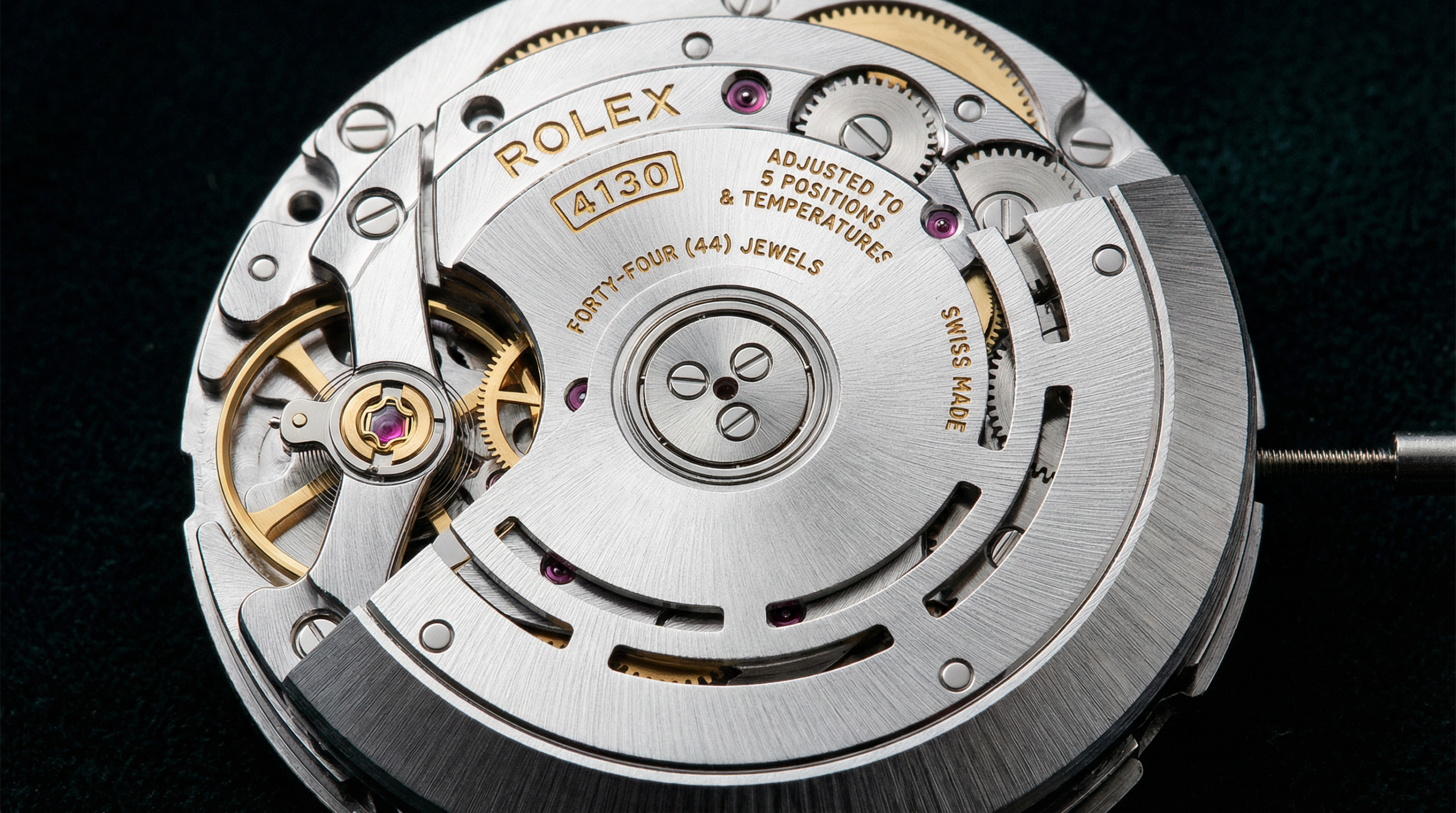
But the true heart of the Daytona is its movement. The caliber 4130, a self-winding mechanical chronograph movement entirely designed and manufactured by Rolex, is a marvel of modern watchmaking. It is a COSC-certified chronometer, a designation reserved for the most accurate and reliable movements in the world. The movement’s vertical clutch system ensures a precise and instantaneous start to the chronograph function, while its Parachrom hairspring provides excellent resistance to shocks and temperature variations. The finishing on the movement, while not visible through the solid caseback, is a testament to Rolex’s unwavering commitment to quality and craftsmanship. The movement is also equipped with a 72-hour power reserve, which means that it will continue to run for three days even if it is not worn.
XIII. The Central Dilemma
The central dilemma for any Rolex Daytona investor is the tension between wearing and preserving the asset. A Rolex Daytona is a beautiful and functional object, designed to be worn and enjoyed. However, it is also a valuable and appreciating asset, and its value is directly tied to its condition. A watch that is worn regularly will inevitably accumulate scratches, dings, and other signs of wear, which can significantly impact its resale value. A watch that is kept in a safe, unworn and in pristine condition, will retain its maximum value, but its owner will be deprived of the pleasure of wearing it.
This dilemma is most acute for owners of rare and valuable vintage models, where originality and condition are paramount. A vintage Daytona with its original, unpolished case and a beautifully patinated dial is a holy grail for collectors, and it will command a significant premium over a watch that has been polished or has had its dial replaced. However, the temptation to wear and enjoy such a watch is strong, and it is a decision that every Daytona owner must grapple with. There is no right or wrong answer, and it ultimately comes down to the individual owner’s priorities and risk tolerance. Some will choose to wear their watches and accept the inevitable depreciation, while others will choose to preserve their investment and admire their watches from afar. Some collectors have even been known to buy two of the same watch: one to wear and one to keep in the safe. This is a luxury that few can afford, but it is a testament to the central dilemma that all Daytona owners face.
XIV. The Next Frontier
The Rolex Daytona market is constantly evolving, and several emerging trends and opportunities are poised to reshape the landscape in the years to come.
1. The Rise of Certified Pre-Owned: In a move that sent shockwaves through the industry, Rolex recently launched its own Certified Pre-Owned (CPO) program. This program allows authorized dealers to sell second-hand Rolex watches that have been authenticated and serviced by Rolex itself. The CPO program is a direct challenge to the grey market, and it has the potential to bring a new level of transparency and trust to the pre-owned market. For investors, the CPO program offers a new and secure way to acquire pre-owned Daytonas with the peace of mind that comes with a Rolex-backed guarantee. It also has the potential to put a floor under the prices of pre-owned Daytonas, as it will create a new and reliable source of supply.
2. The Financialization of Watches: The trend of watches as an asset class is only set to continue. We are likely to see the emergence of new and more sophisticated investment vehicles, such as watch-focused ETFs and derivatives. These products will make it easier for a wider range of investors to gain exposure to the watch market, which could further fuel demand and price appreciation. The rise of fractional ownership platforms is also making it possible for a wider range of investors to own a piece of a high-value watch. This is a trend that is likely to accelerate in the coming years, and it could have a significant impact on the Daytona market.
3. The Rise of the Neo-Vintage: As prices for vintage Daytonas continue to climb into the stratosphere, collectors are increasingly turning their attention to “neo-vintage” models from the 1980s, 1990s, and 2000s. These watches offer a compelling combination of vintage aesthetics and modern reliability, and they are still relatively affordable compared to their older counterparts. The Zenith-powered Daytonas (ref. 16520) and the first in-house Daytonas (ref. 116520) are particularly well-positioned to appreciate in value in the coming years. These watches are seen as the next frontier of vintage collecting, and they are already starting to see a significant increase in demand.
4. The Impact of Blockchain: Blockchain technology has the potential to revolutionize the luxury watch market by providing a secure and transparent way to track the ownership and provenance of watches. Several companies are already working on blockchain-based solutions for authenticating luxury goods, and it is only a matter of time before this technology is widely adopted in the watch industry. This will help to combat the problem of counterfeiting and it will give buyers and sellers greater confidence in the authenticity of their watches. It will also make it easier to track the service history of a watch, which will further enhance its value and desirability.
XV. Lessons from History
The Rolex Daytona phenomenon, while unique in its own right, is not without historical precedent. The history of financial markets is replete with examples of asset bubbles, where the price of an asset becomes detached from its intrinsic value, driven by speculation and a fear of missing out. By examining these historical parallels, we can gain a better understanding of the potential risks and rewards of investing in the Daytona market.
1. Tulip Mania (1634-1637): The Dutch Tulip Mania is the archetypal example of a speculative bubble. In the 1630s, the price of tulip bulbs in the Netherlands skyrocketed to absurd levels, with some rare bulbs trading for more than the price of a house. The bubble was fueled by a combination of factors, including the novelty of the tulip, the limited supply of rare bulbs, and a culture of rampant speculation. The bubble burst in 1637, and prices for tulip bulbs collapsed, ruining many investors.
The Lesson: The Tulip Mania serves as a cautionary tale about the dangers of irrational exuberance and the herd mentality. While the Rolex Daytona is a far more substantial asset than a tulip bulb, the parallels are clear. The Daytona market is driven by a similar combination of scarcity, desirability, and speculation, and it is not immune to the same forces that brought the tulip market crashing down. The key difference, however, is that the Daytona has a much stronger underlying value proposition. It is a high-quality, functional object with a rich history and a powerful brand behind it. This gives it a degree of resilience that the tulip bulb never had.
2. The Beanie Baby Bubble (1990s): In the 1990s, a line of plush toys called Beanie Babies became a cultural phenomenon. The manufacturer, Ty Inc., created a sense of scarcity by retiring certain models and limiting production. This fueled a speculative frenzy, with some rare Beanie Babies trading for thousands of dollars on the secondary market. The bubble burst in the late 1990s, and the value of most Beanie Babies plummeted, leaving many collectors with worthless collections.
The Lesson: The Beanie Baby bubble is a modern-day example of how a company can manufacture scarcity to create a speculative frenzy. The parallels to the Rolex Daytona market are striking. Rolex, like Ty Inc., has masterfully created a sense of scarcity and exclusivity, which has fueled the explosive growth of the secondary market. The Beanie Baby bubble serves as a reminder that what goes up can also come down, and that the value of a collectible is ultimately determined by the whims of the market. The key difference, however, is that the Daytona is a much more substantial and enduring asset than a Beanie Baby. It is a product of a century of watchmaking expertise, and it is a symbol of timeless style and quality.
3. The Fine Art Market: The fine art market is perhaps the closest parallel to the luxury watch market. Both are markets for tangible, non-income-producing assets, and both are driven by a combination of passion, connoisseurship, and investment. The fine art market has a long history of booms and busts, but over the long term, it has proven to be a resilient and appreciating asset class. The works of master artists like Picasso and Warhol have consistently appreciated in value, and they have become a staple of many high-net-worth investment portfolios.
The Lesson: The fine art market demonstrates that a market for collectibles can be a legitimate and sustainable asset class. The key is to focus on quality, rarity, and historical significance. The Rolex Daytona, with its iconic design, rich history, and limited production, shares many of the same characteristics as a great work of art. The fine art market provides a roadmap for how the Daytona market could evolve in the years to come, with a growing focus on connoisseurship, scholarship, and long-term value creation. The key to success in both markets is to buy the best you can afford and to hold for the long term.
XVI. The Risks
Investing in a Rolex Daytona, like any investment, is not without its risks. While the potential for appreciation is significant, investors must be aware of the potential downsides.
1. Market Risk and Price Volatility: The luxury watch market is subject to booms and busts, and the Daytona is not immune. The 2022 market correction, which saw prices for some models fall by as much as 30%, is a stark reminder that the Daytona market can be volatile. While prices have since stabilized, there is no guarantee that they will not fall again in the future. The Daytona market is also highly susceptible to changes in fashion and consumer tastes. What is popular today may not be popular tomorrow, and this can have a significant impact on prices.
2. Counterfeiting and Fraud: The high value of the Rolex Daytona makes it a prime target for counterfeiters. The market is flooded with fakes, some of which are so convincing that they can fool even experienced collectors. Investors must be vigilant and only buy from reputable dealers and auction houses. The rise of blockchain-based authentication solutions may help to mitigate this risk in the future, but for now, it remains a significant concern. It is also important to be aware of the risk of fraud. There have been numerous cases of dealers and private sellers who have sold watches that are not as described, or who have taken payment and then disappeared.
3. Theft and Insurance: A Rolex Daytona is a small, portable, and highly valuable asset, which makes it a target for thieves. Investors must take appropriate security measures to protect their watches, and they should ensure that their watches are adequately insured. The cost of insurance can be significant, and it is a cost that must be factored into the overall investment equation. It is also important to be aware of the risk of theft in transit. When shipping a watch, it is essential to use a reputable and insured courier.
4. Liquidity Risk: While the Rolex Daytona is one of the most liquid luxury assets in the world, it is not as liquid as a stock or a bond. It can take time to find a buyer for a watch, and the transaction costs can be high. In a down market, it may be difficult to sell a watch at a fair price, and investors may be forced to sell at a loss. The liquidity of the Daytona market is also highly dependent on the specific model and reference. The modern stainless steel models are the most liquid, while the precious metal and gem-set models are less so.
5. The Risk of Damage: A Rolex Daytona is a delicate and complex piece of machinery, and it is susceptible to damage. A watch that is dropped or mishandled can be expensive to repair, and the damage can significantly impact its value. Investors must handle their watches with care and ensure that they are serviced regularly by a qualified watchmaker. The cost of servicing a Daytona can be significant, and it is a cost that must be factored into the overall investment equation.
XVII. The Alternative Fortune Verdict
The Rolex Daytona is more than just a watch; it is a cultural phenomenon, a triumph of marketing, and a legitimate alternative asset class. Its meteoric rise in value is a testament to Rolex’s masterful control of supply and demand, and its enduring appeal to collectors and investors alike. While the risks are real, the potential rewards are significant, and the Daytona has proven to be a resilient and appreciating asset over the long term.
For those with the capital, the risk tolerance, and the passion for horology, the Rolex Daytona can be a rewarding and profitable investment. However, it is not an investment for the faint of heart. It requires a deep understanding of the market, a network of trusted contacts, and a willingness to navigate the complexities of the authorized dealer game and the grey market.
Before taking the plunge, here are some due diligence questions to ask yourself:
- •What is my investment horizon? The Daytona is a long-term investment, and it is not suitable for those who are looking for a quick profit.
- •What is my risk tolerance? The Daytona market can be volatile, and there is no guarantee that prices will continue to appreciate.
- •Do I have a trusted network of dealers and experts? The Daytona market is opaque and relationship-driven, and it is essential to have a network of trusted contacts.
- •Am I passionate about watches? Investing in a Daytona is more than just a financial transaction; it is an investment in a piece of history and a work of art. If you are not passionate about watches, you are unlikely to have the patience and dedication required to be a successful Daytona investor.
If you can answer these questions with confidence, then the Rolex Daytona may be the right investment for you. It is a challenging and complex market, but for those who are willing to do their homework, the rewards can be immense.